
If anyone is wondering why I’ve suddenly started saying ‘AI’ it’s because I’ve (reluctantly) accepted this is a necessary requirement for communicating effectively in higher education policy work. I still think we should be talking about models and will continue to write about them in my theoretical work.
What does it mean for students to use AI in active rather than passive ways? In Generative AI for Academics I talked about the difference between thinking with AI and using AI as a substitute for thinking. This roughly maps onto the cognitive outsourcing concept which I’ve argued we need to move away from. It’s too binary a distinction to capture the complexity of how users engage with AI, even if it does nonetheless track a meaningful distinction which matters. In some cases a user is actively thinking about their use and in other cases they are not. Furthermore, this is a distinction in practice which matters in principle. What it means to use AI is different if you are thinking about the use you are making of it. It doesn’t necessarily mitigate the risks but ceteris paribus it’s better to think about your use then not think about it.
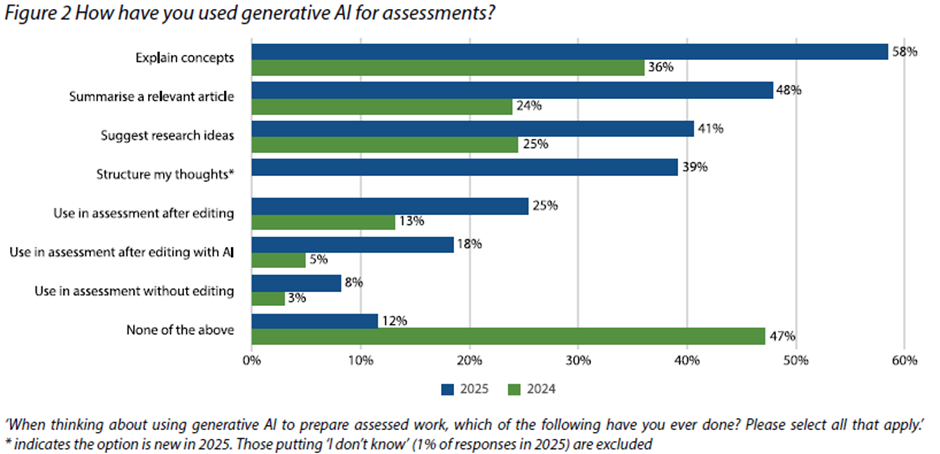
I’ve tried two routes towards fleshing out this distinction as a spectrum. The first is to look at specific practices which a student might engage with in relation to AI. For example the HEPI (2025) research shows a variegated picture in terms of what students have used AI for in assessments. I’ve argued these practices range from the obviously problematic (use in assessment without editing) or obviously acceptable (explain concepts*) but that most are an ambiguous middle-ground in which context-sensitive judgements have to be made in terms of cohort characteristics, disciplinary standards and assessment design. This helps crack open the black-box of AI practice (treating AI use as if it’s fundamentally interchangeable rather intensely varied) but it doesn’t really address the question of what active use actually is. It simply restates the problem at a more granular level of specific practices which we can either assume to be active or passive in all usual cases or which we can inquire about activity or passivity in context-sensitive terms.
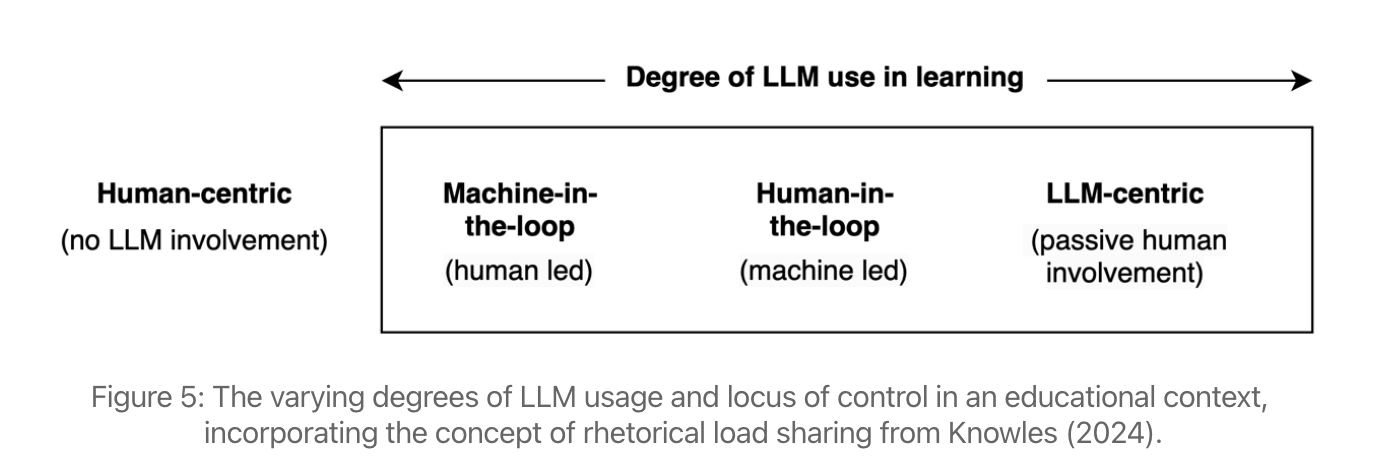
The other strategy was to use this notion from Jonathon Jackson’s interesting account of degrees of LLM use in learning. He suggests we need to design learning activities which inculcate the habit of shifting left so that if students reach human-in-the-loop or llm-centric use then they do not remain there. This feels important to me because it highlights how active use is something which has to be worked at longitudinally. It suggests that if we incorporate AI into learning we should do so in a way which ensures a left-shift is likely. This is particularly important when we consider the structural drivers of habituation which are going to intensify in consumer-focused subscription based LLMs over the coming years. If the student is not going to opt out entirely (and obviously they can’t if we’re building this into an assessment) then what matters becomes developing the inclination to pull back into more active forms of use.
In neither case have I really addressed the question though. What is active use? The notion of epistemic agency (introduced to me by Peter Kahn) offers a way through which we might begin to think about this question. Juuso Henrik Nieminen, Eeva Haataja & Peter J. Cobb offer hints of a potential answer in this paper. They define this for students as “their sense of agency in using, evaluating and producing knowledge” (970). It’s the outcome of “students’ transformational relationship with knowledge” (972) facilitated (or frustrated) by the environment in which teaching and learning is taking place. In a case study of student epistemic agency in authentic assessment they define the following area of focus for their inquiry (my bold):
We first focused on students’ accounts of their epistemic actions: how they explained learning and studying as they progressed in the course. We then analysed how these actions reflected students’ orientation to knowledge: how they positioned themselves with respect to knowledge in digitally-mediated authentic assessment
Pg 977
Note that the first concept is emic: how do students account for their learning and progress. The second concept is etic: what can we infer from their actions about their orientations towards knowledge? This split is important I think because it enables us to take student narrations of knowledge work seriously without taking them literally. There’s a further level of inference we can make. Therefore we might ask in relation to AI use:
- How do students account for their actions with AI in terms of knowledge?
- What can we infer from student actions about their orientation towards knowledge?
In their analysis they offer a number of themes which can help us clarify what to look for in relation to these questions:
- A sense of being an active learner
- A sense of being a user of knowledge
- A sense of contributing to society
These are all things we can ask students about in their use of AI. To what extent do they feel they are using it an active way? It’s a fallible guide but we can nonetheless talk to students about whether it feels like they are learning (thanks to David Meecham for this point). It’s a phenomenological datapoint that can be taken seriously. Likewise we can ask them about the extent to which they feel they are actively engage with knowledge when they use AI? Does it feel like they are passive recipients or that they are linking thinks together in active ways? An interesting point in the paper was the role of interdisciplinarity and the acts of synthesis it invites in bringing this about.
In another paper Juuso Henrik Nieminen and Laura Ketonen talk about the same concept of epistemic agency in terms of assessment more broadly. They argue that what I think of as the promissory function of assessment (ensuring that a student given a credential has the learning the credential claims) and the stakes for students of the ensuing culture undermines an active and transformative engagement with knowledge. If it’s all about validating knowledge conceived of as a property of the individual student then the active engagement (facilitated by the environment) will tend to be neglected. Likewise a focus on employability skills too easily leads to a focus on discrete competencies to be reproduced in the workplace rather than the more diffuse meta-competency (?) which might or might not underlie them. If assessment is targeted at demonstrations of knowing rather than knowing it leaves us with a performative assessment culture.
It’s important that epistemic agency is conceived of in terms of the environment which facilitates or frustrates it. We encounter active or passive use of AI at the level of the individual student and the specific practices they are engaged in. I suggested in the previous post that we might see cognitive ownership at the task level and the learning journey level. The tasks which constitute the student’s learning (including informal learning) jointly combine into a learning journey which is characterised by a certain degree of cognitive ownership. What I’m talking about as cognitive ownership maps onto the phenomenological sense of being an active learners and being a user of knowledge. These are present at the task level and they jointly combine into characteristics of the learning journey.
The evaluative level which the student cannot conclusively adjudicate on is whether a sense of (actual) cognitive ownership is matched by (real) epistemic agency. It’s the latter question which forces us to look again at the context. To what extent is the learning environment (encompassing everything from learning design through to assessment and institutional provision of resources) facilitating epistemic agency? We’ve already seen from the second paper how assessment culture can frustrate epistemic agency at the learning journey level even if it might flicker into being at the task level. This gives us a framework for thinking about institutions as enabling epistemic agency by making it easier for students to use AI in active ways defined by cognitive ownership. It means we need to design environments that make this easier, as well as supporting activities and assessments which make this easier.
So what does it mean to talk about a student using AI in an active way? This is what I’m gesturing towards though it is still provisional:
- An experienced sense of being an active learner
- An experienced sense of actively working with knowledge
- A transformative engagement to knowledge (Nieminen and Ketonen) i.e. the student’s understanding is changed by the interaction
- The capability is retained in spite of the AI use (Pritchard’s challenge here)
I think this use is possible. In future posts I’ll have a go at defining it in concrete terms with examples. It’s a high threshold though: it’s ok if not all use meets this threshold but that’s exactly why we should left-shift in Jackson’s terms. It also means we should discourage use which does not incline towards this threshold because that would be ‘cognitive outsourcing’ in precisely the sense in which so many academics are worrying about it.
*The one pushback I had to this was that ‘explaining concepts’ is a problem because of the anglocentric bias of the corpus. Surely this would suggest though that ‘explaining concepts’ using resources from a library or articles from a journal system that hasn’t been colonised would be equally problematic? It seems like a category error to treat this as a problem specific to LLMs (as opposed to other knowledge sources) but I can see the specific risk that LLMs launder objectivity by presenting themselves as authoritative new sources of neutrality. But this itself suggests to me we need to scaffold the practice for students rather than retreat from it.

