I was very sceptical of ‘agentic AI’ until actually exploring Claude Code and Claude Cowork. The latter in particular made the functionality of the former immediately accessible to non-developers. There’s something slightly intoxicating about having an army of minions toiling away on your second screen while you’re focusing on other stuff* which we need to be cautious about. But if you’re thinking about what you’re asking it do, as well as monitoring the outputs, it clearly does radically expand the scope of what you can do as an individual. A recent FT piece suggests the productivity gains of agentic AI are starting to show in software development on a number of measures:
Please use the sharing tools found via the share button at the top or side of articles. Copying articles to share with others is a breach of FT.comT&Cs and Copyright Policy. Email licensing@ft.com to buy additional rights. Subscribers may share up to 10 or 20 articles per month using the gift article service. More information can be found on the Help FAQ on gift articles.
https://www.ft.com/content/5ac2ee5f-f8bd-4f39-a759-3c5c50c8b37eLast September a comprehensive and widely-read analysis by veteran software engineer Mike Judge found essentially no sign of any uptick in software productivity as measured by a range of indicators. These included the volume of code uploaded to projects hosted on the giant coding platform GitHub, volumes of new mobile apps released on Apple’s iOS app store, and new website registrations. I’ve revisited the same measures five months on, and all three show clear upward inflection points by the end of 2025, coinciding with the launch of agentic coding tools such as Anthropic’s Claude Code and OpenAI’s Codex.
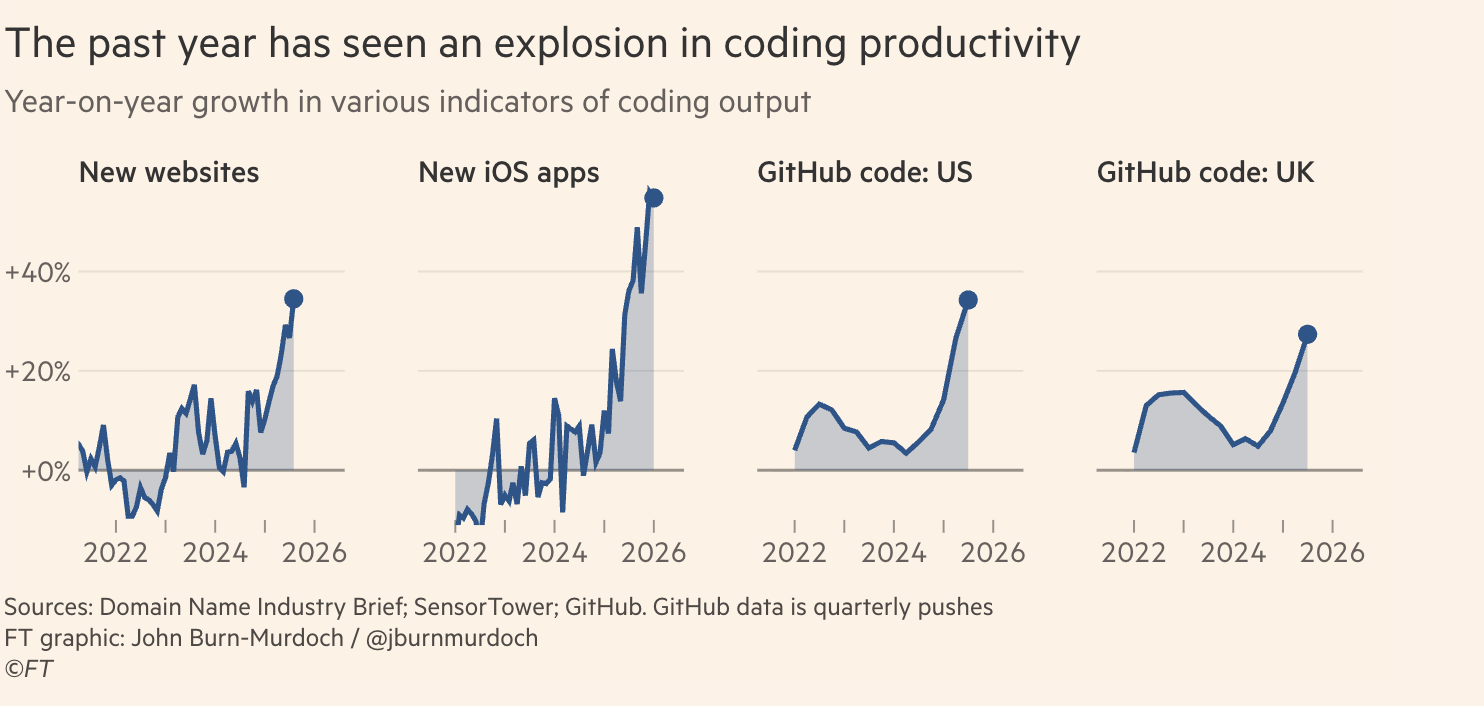
As they point out quantity doesn’t entail quantity. Lots of this will be workslop and/or projects that wouldn’t have been undertaken until the capabilities were there. My Claudes are busily at work on designing an ebook based on my blog which is something I’d always vaguely wanted to do but never would have got round to. But it seems implausible to me to claim all, or even a majority of it, is workslop. I’m increasingly convinced something big is happening here which might equal the sociotechnical story of the first three years of language models being out in the world. Also if Anthropic’s claim that Cowork was built entirely by Claude Code is accurate that seems like something we need to dwell on.
*The poetics of this need to be explored. There’s an awful lot going on in how these developments are being experienced and narrated. Richard Sandford used the phrase “arm chair generals” to me which certainly captured my experience.

