
I found myself wondering about this when I stumbled across a photo I took in London nearly ten years ago. It was jarring to be reminded how visible LLMs were such that they literally took out advertising on the tube.
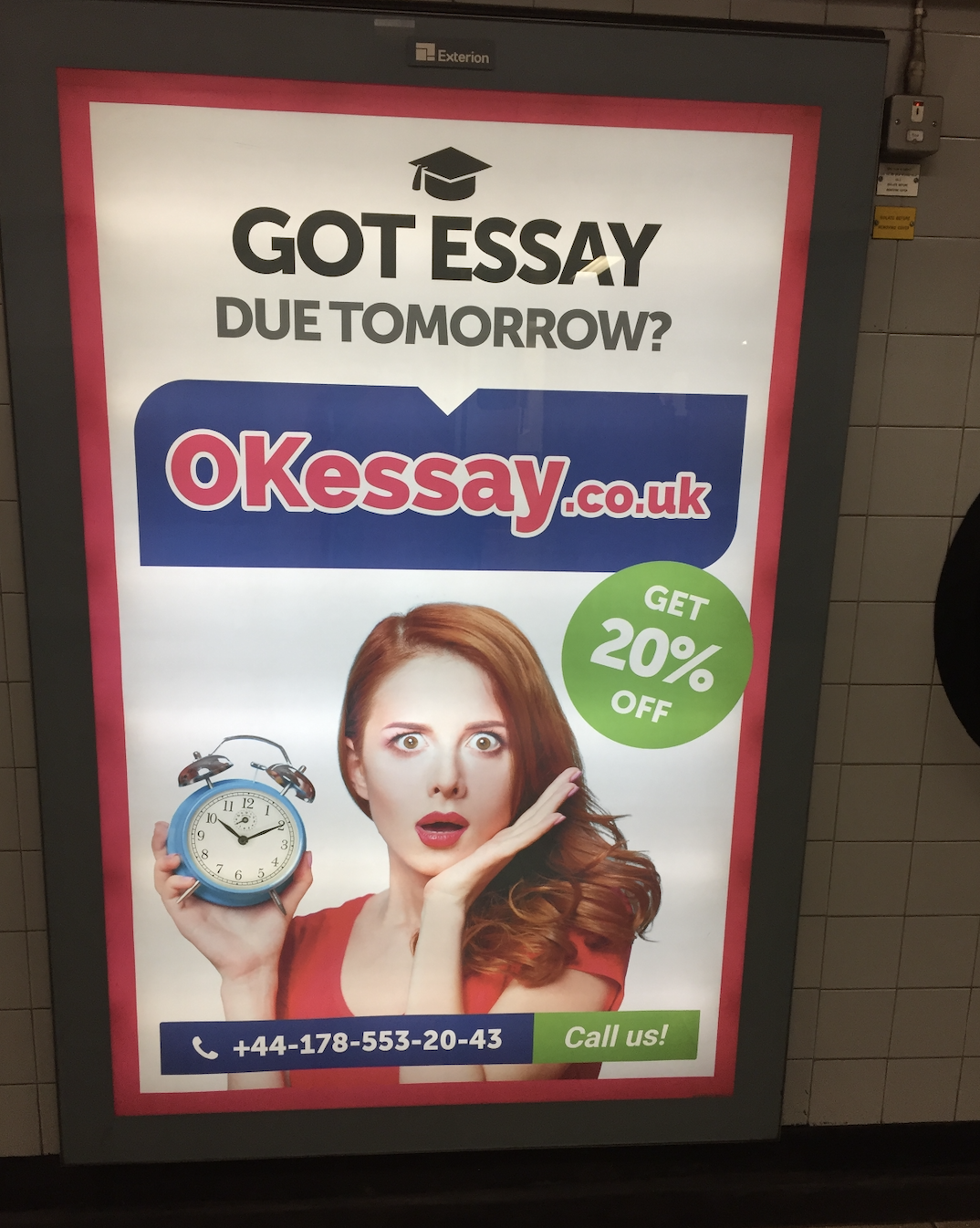
It’s ironic these were banned in the UK only months before the launch of ChatGPT. The language of the policy suggests potential complexity about its implementation:
It is now a criminal offence to provide or arrange for another person to provide contract cheating services for financial gain to students taking a qualification at a post-16 institution or sixth form in England, enrolled at a higher education provider in England and any other person over compulsory school age who has been entered for a regulated qualification at a place in England.
Similarly, it is now an offence for a person to make arrangements for an advertisement in which that person offers, or is described as being available or competent, to provide or arrange for another person to provide a cheating service. Importantly, the offence centres around the act of advertising to students, and for the offence to be committed it does not need to be seen by its target demographic.
Don’t get me wrong. This was clearly a good thing. But given how much of a drugs trade (as well as a fraud trade predicated on getting people to transfer money for non-existent drugs) exists through mass commercial social media platforms, it’s difficult to imagine that a prohibition would be particularly effective. It would increase the costs of doing business and make essay mills less accessible to those students who were only dimly curious about the possibility. But it wouldn’t remove them from the internet.
Obviously LLMs were a different proposition. Why pay hundreds of pounds for an essay that can be produced through a chatbot? This was always more complex than it was imagined such that we’re only now (with Claude 4.5, Gemini 3 and GPT 5.2 as well as their deep research functions) when you can meaningfully hope to produce a ‘good’ essay based on the title alone. But how much of the work of essays mills was ‘good’ in the first place? Obviously the economic proposition which essay mills made to students fundamentally changed, suggesting a plausible possibility that LLMs overnight decimated any potential mass market for contract cheating.
Interestingly Joseph Thibault suggests that traffic has declined significantly but the essay mills have not died off:

While AI writing tech (not frontier models or wrapped products but services explicitly offering writing help to students, including ‘humanising’) traffic has jumped:
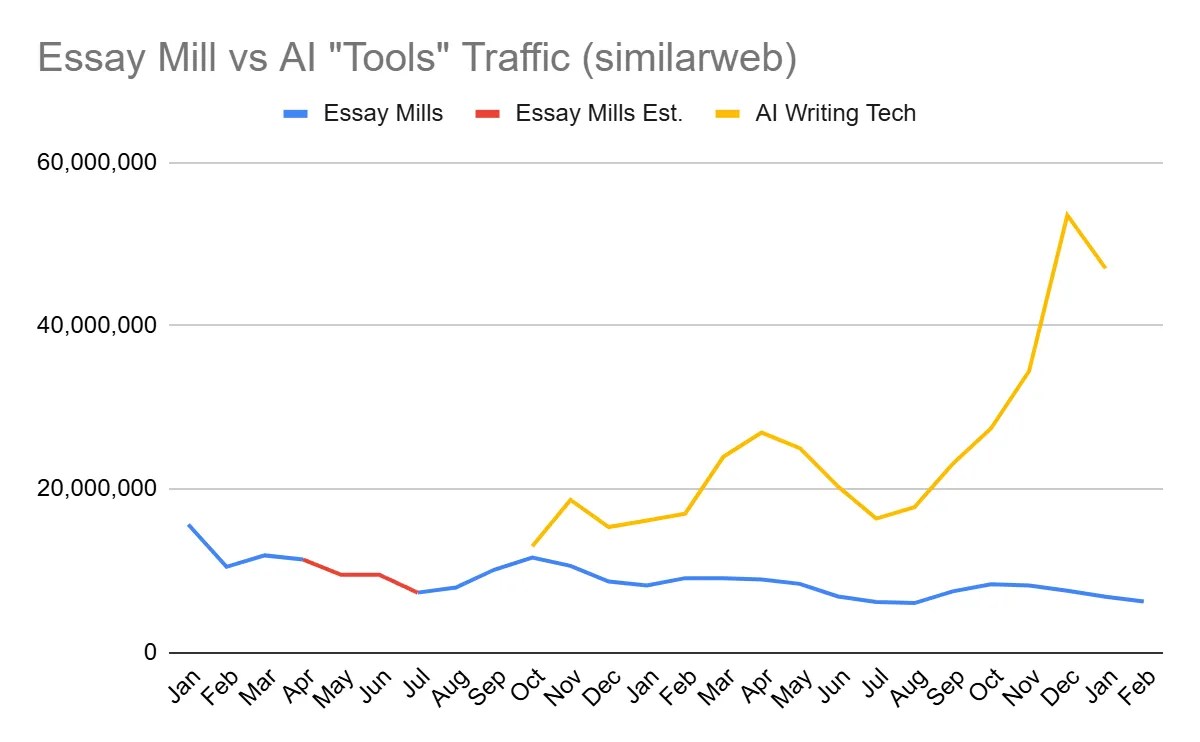
If the database he’s curating is reasonably representative this is good prima facie evidence for thinking that essays mills haven’t died and also suspecting that parts of the industry have pivoted into AI-enabled cheating. This raises the question of why they haven’t died? How have their offerings changed? Who is paying for them? Are writers now using LLMs themselves? How do students distinguish between automated writing and human expert writing? There’s a cruel irony in the image of students paying for contract cheating that is effectively done by someone using an LLM that the student could have accessed themselves.
Could the great assessment panic have ironically propped up this market by creating such anxiety amongst students about what counts as ‘cheating with AI’ that they find it reassuring to continue to buy these products from an essay mill instead?
Interesting that there have been no recorded offences under the law:
However, both the Crown Prosecution Service and the Department for Education told the BBC they had no recorded offences reaching a first hearing in a magistrate’s court under the Skills and Post-16 Education Act.
 Mark Carrigan