

I highly recommend Deep Change and Emergent Structures in Global Society: Explorations in Social Morphogenesis by Andrea Maccarini. It might be slightly difficult if you’re not familiar with the morphogenetic approach but it’s worth persisting with because there’s so much deep insight here on questions of social change and educational change. This passage from pg 248 succinctly expresses something which has inchoately motivated my work since my PhD and which I’ve never even come close to getting into words:
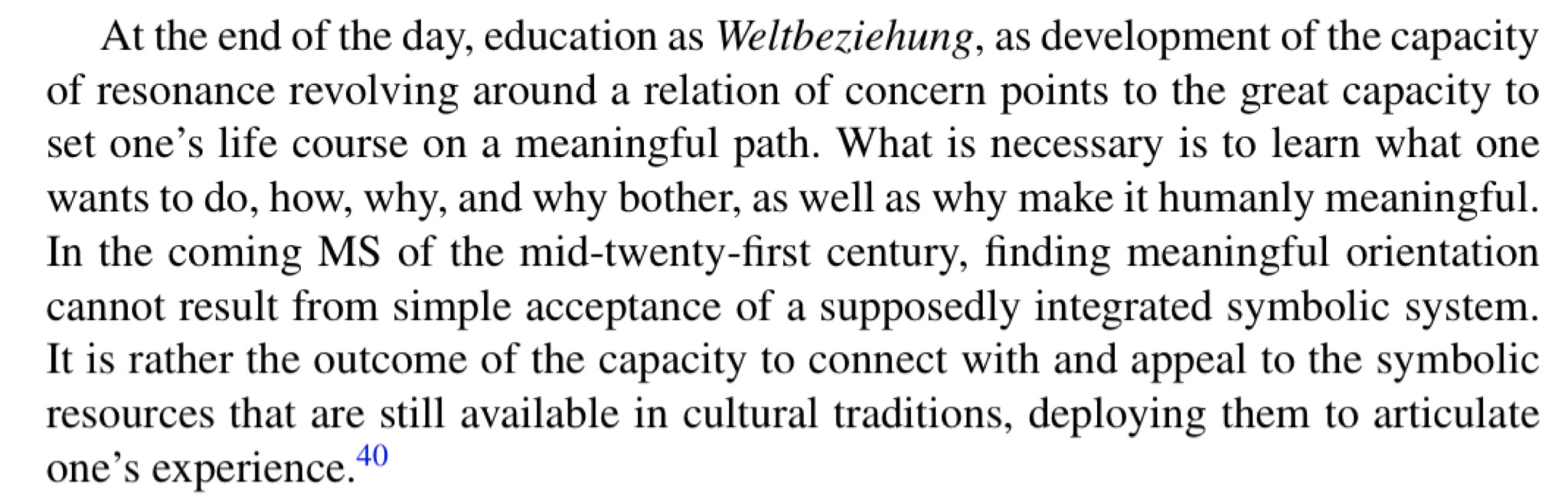
In essence the claim is that something fundamental has changed about socialisation. We can’t find meaning in the world, in the sense of a process of maturing and coming to find a place for ourselves which is satisfying and sustainable, simply through the internalisation of a symbolic order and/or the replication of our natal circumstances. In contrast to the individualisaiton theorists like Beck, Bauman and Giddens, he’s not saying that we live in a post-traditional order but rather that our relations to tradition have to be worked at and can’t simply be inherited.
This is where my interest in platform socialisation comes in. Social platforms increasingly mediate access to the symbolic resources of society, with a number of distinctive dynamics which tend to follow from this:
- They increase the potential range of social and cultural variety which is accessible to an an enormous degree. There are lifeworlds which can be peered into from a mobile device in a bedroom which literally span the globe.
- They constraint the actual range of social and cultural variety because of dynamics internal to the platforms themselves. Algorithmic and network filtering are unavoidable features of these cacophonous social venues which will tend to restrict what’s encountered in ways which might not always be obvious to the user.
- They generate tendencies in how users express themselves through the platform (e.g. the pursuit of visibility, the incitement to perform) which changes what is en countered in subtle but significant ways.
In this sense, how young people orientate themselves to social platforms becomes an integral part of how they orientate themselves towards the socialisation process. Andrea convincingly argues that the role of the teacher must shift under these conditions, taking on a responsibility for mediating what Rosa calls resonance (i.e. students coming to an awareness of what matters to them) and facilitating their self-knowledge. I’d argue that platform socialisation represents the other side of this and is something which must be incorporated into education.
 Mark Carrigan