
As I too often find myself doing in these situations, I’ve been browsing hashtags and newspaper comments about the tube strike. The most obvious recurring theme concerns the putative comfort of the striking tube workers: how do they justify striking when they’re already so well off?
In actuality, salaries of tube workers range between £24,000 and £50,000. The Telegraph’s chart shows how this compares to other public sector workers. Much as public sector workers as a whole must have their pay and conditions beaten down because it would be unfair to private sector workers, this perverse conception of fairness demands that the same race to the bottom be conducted across the public sector itself.
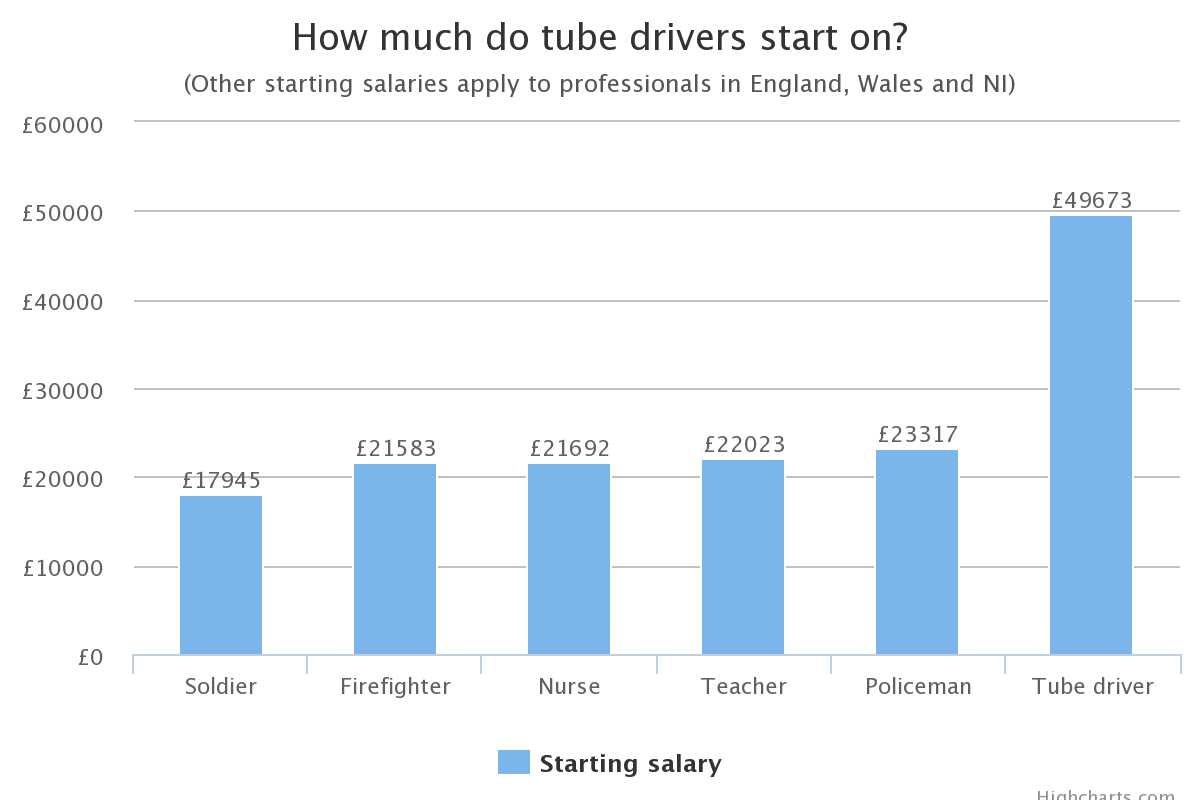 However only a couple of months ago, a well publicised KPMG report concluded that first-time buyers needs to earn £77,000 per year to get on the housing ladder in London. The average annual wage in the capital might be £27,999, in relation to which many of the tube workers do indeed seem to be secure, but this shows how far wages across London lag behind the continually sky rocketing cost of living. Surely the message from the RMT needs to be: we’re not paid too much, you’re paid too little? Or will this seem too crude?
Left to its own devices negative solidarity (“why should they have to struggle less than I do?”) will corrode what little capacity for collective sentiment that remains within a world city rapidly becoming a playground for the super-rich comparable to anything else in history. What discursive strategies can be used to combat it? The other manifestation of it I noticed is in the sentiment “I can’t strike, so why should they be able to?”. I’ve encountered this a few times, though much less frequently than the ‘greedy tube workers’ notion.
 Mark Carrigan