
Pretty much the entirety of my morning yesterday was consumed by trying to purchase new glasses. I already find eye tests a weirdly difficult experience because the analytical voice in my head can’t help but reflect on the naive empirical perception that the exercise is supposed to elicit and the work being done by rather vague terms like ‘1’, ‘2’ and ‘sharper’. It would be nice to find that other people have this experience as well but I suspect it’s probably just me.
However I think the equally time consuming process of subsequently choosing glasses probably reflects more than my own strangeness. After the eye test, I was given a voucher for £99 off a second pair of glasses if I bought an initial pair of frames over £150. I’d set out to buy two pairs in the first place so I enthusiastically embraced the choice architecture they’d constructed for me and went searching for an initial pair. l spent some time randomly trying frames on which caught my eye before realising that all the glasses were either £100-£140 or £220-£350. This realisation occurred after a helpful (?) member of staff had given me a tray upon which to store the glasses that I liked, soon finding myself with 8 frames susceptible to various possibilities (using the voucher or not) when it came to purchasing them.
After eventually resorting to mental arthritic in a way which completely pulled me out of the liminality into which the consumer is supposed to enter, I concluded that using the voucher would either lead me to spend a lot more money than I otherwise would or lead me to choose frames that I didn’t actually want in order to save a small amount of money. Then a failed attempt to purchase prescription sun glasses added another 20 minutes to this process which I won’t bore you with. Eventually I thought this drawn out process, for which I had little enthusiasm to begin with, had finally drawn to a close. But then I was presented with the issue of lenses: I had to choose between 4 gradations of thinning, ranging from £0 to £150, each with distinct implications for each specific pair of frames on an aesthetic level. The instrumental rationality which was the only way I’d managed to make a choice in the first place was instantly thrown into disarray.
 The choice I made does on reflection seem to have been the right one on instrumental grounds but it was one I made at the time purely to bring the process to a close. Three things struck me about the experience: (1) how falling back upon calculative rationality, once I’d selected a subset of the options on aesthetic grounds, was the only way I was able to make any decision (2) how that calculative rationality was almost immediately upended by a new dimension to the decision which was only introduced after selecting the frames (3) how exhausted I felt by that point in the transaction.
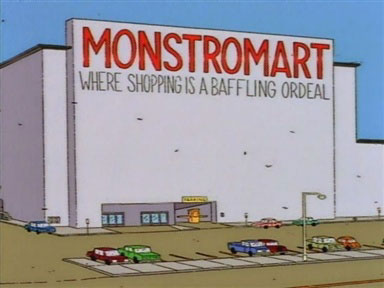
Experiences like this always make me think back to Monstromart in the Simpsons: where shopping is a baffling ordeal. Last time I thought about this, I’d been browsing the cold & flu pills in Boots, utterly unable to make a decision. Lacking any criteria for choice, I looked at the ingredients list and was amazed to discover that the only difference (other than price and packaging) between the 16+ products they had was whether there was caffeine or ephedrine in the remedy.
If behavioural scientists are right about decision fatigue then there’s an important sense in which consumer capitalism might be contributing to our passivity, above and beyond the sense implied by familiar critical denunciations of pseudo-choice (which I nonetheless think have value because the whole thing always feels so vividly stupid when I’m faced with a row of identical products and just want something that works). If we have a finite capacity to make choices over the course of day, we should take seriously the impact that trivial consumption decision have aggregatively upon our decision making in other aspects of our lives. We also need to remember that this is something which corporate bureaucracies, not themselves prone to decision fatigue, seek to exploit through all manner of strategies. I’m interested in understanding this further, as well as making sense of how front line staff mediate this in perhaps unintentional ways: for instance have you ever found yourself been asked to justify your decision not to purchase a ‘meal deal’ (etc) when you actually don’t want the additional items you’d receive?
 Mark Carrigan