After weeks of niggling injuries I returned to distance running this morning for the first time in a couple of months. I’d been widely assured that despite my catastrophising it really wasn’t possible to have lost much fitness and strength in eight weeks. Yet in practice it was newly exhausting to run a distance I could have done pretty casually back in May. It left me pining for something I saw a lot at the last competitive race I did:
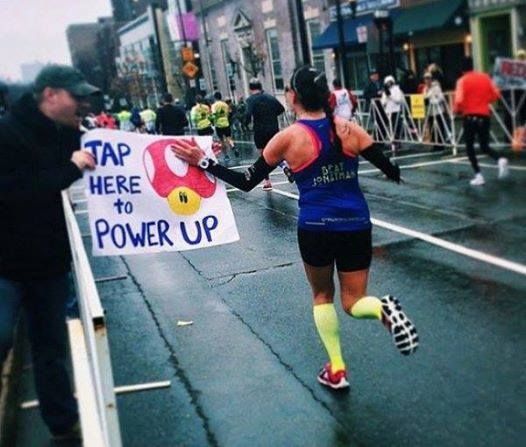
I really like these signs. Once I got over feeling silly about doing it, I found that tapping the power up does indeed make me feel powered up. What’s going on here? If you accept my experience that this is, at least mildly, energising then the obvious explanation is that it’s energising because it’s fun. But what does it mean for it to be fun? It’s fun in part because the signifier itself carries traces of past fun. For anyone who spent years playing Mario Kart the idea of a mushroom that you tap to go faster resonates with diffuse memories of hours playing a fun game, individually and in groups. The sense of acceleration in the game, particularly when you’re falling behind and a judiciously timed mushroom leaves you rushing back ahead, translates into the context of the race. A sceptical voice in me points out that I actually start accelerating before I tap the mushroom. Part of the fun is rushing to tap the power up, before rushing forward newly powered up. But this in itself is a response to the signifier. It carries the capacity to induce a response which is in a real sense causal even if that capacity can only accumulate through iterated engagements with the signifier over time. It’s not a nostalgic phenomenon because it’s very much present tense. The past fun is in a sense present now even if it’s force relies entirely on the past engagements.
It makes me think of Mari Ruti’s description in The Creative Self of “tiny morsels of jouissance latching themselves onto the underbellies of select signifiers so as to give them the kind of boost that enables them to resuscitate the domain of signification” (loc 1225). Each of those countless games of Mario Kart is a little barnacle attached to the underbelly of the mushroom on the sign, perfectly attuned to the libidinal economy of the race itself. It’s good to get a power up in a half marathon for pretty similar reasons to it being good to get a power up in a game of Mario Kart. The fact it’s offered in a spirit of support, such that solidarity is expressed through making and sharing the sign, amplifies this but I don’t think it creates it. I can’t think of another sign at a race that has had this effect. Occasionally good jokes make me laugh, which can in turn cheer me up if I’m feeling exhausted and miserable. But that’s more a situational response to occasional wonderings of “why am I doing this to myself?” rather than something which directly acts on me in a libidinal sense.
I find the idea that the signifier itself as a causal power, albeit dependent on the individual’s past history of engagement with that signifier, vastly more plausible than a sceptical reading which suggests that at best this is just people responding emotionally to a supportive crowd. Without engaging with the signifiers through which that support intervenes in the race, these are just general platitudes rather than specific claims about identifiable effects which forms of support have on particular runners. I find it interesting to think this through in relation to the mushroom sign because transposing a signifier from a racing game to a running race makes it easier to see the causal forces at work. It leaves the prior influences more easily legible than they would otherwise be. But one of the things I’ve learned from Lacan is that signifiers are working on us constantly, in often profound and idiosyncratic ways, in a manner which much sociology (particularly the school I was trained in for all its other virtues) is pretty incurious about and unresponsive to.


