These beautiful passages from The Trip to Echo Spring: On Writers and Drinking immediately made me think of Lacan:
At some point, you have to set down the past. At some point, you have to accept that everyone was doing their best. At some point you have to gather yourself up, and go onward into your life.
Pg 291
I mean we all carry something inside us that ca be rejected; that can look silver in the light. You can deny it, or try and throw it in the garbage, by all means. You can despise it so much you drink yourself halfway to death. At the end of the day, though, the only thing to do is to take a hold of yourself, to gather up the broken parts. That’s when recovery begins. That’s when the second life – the good one – starts.
Pg 297
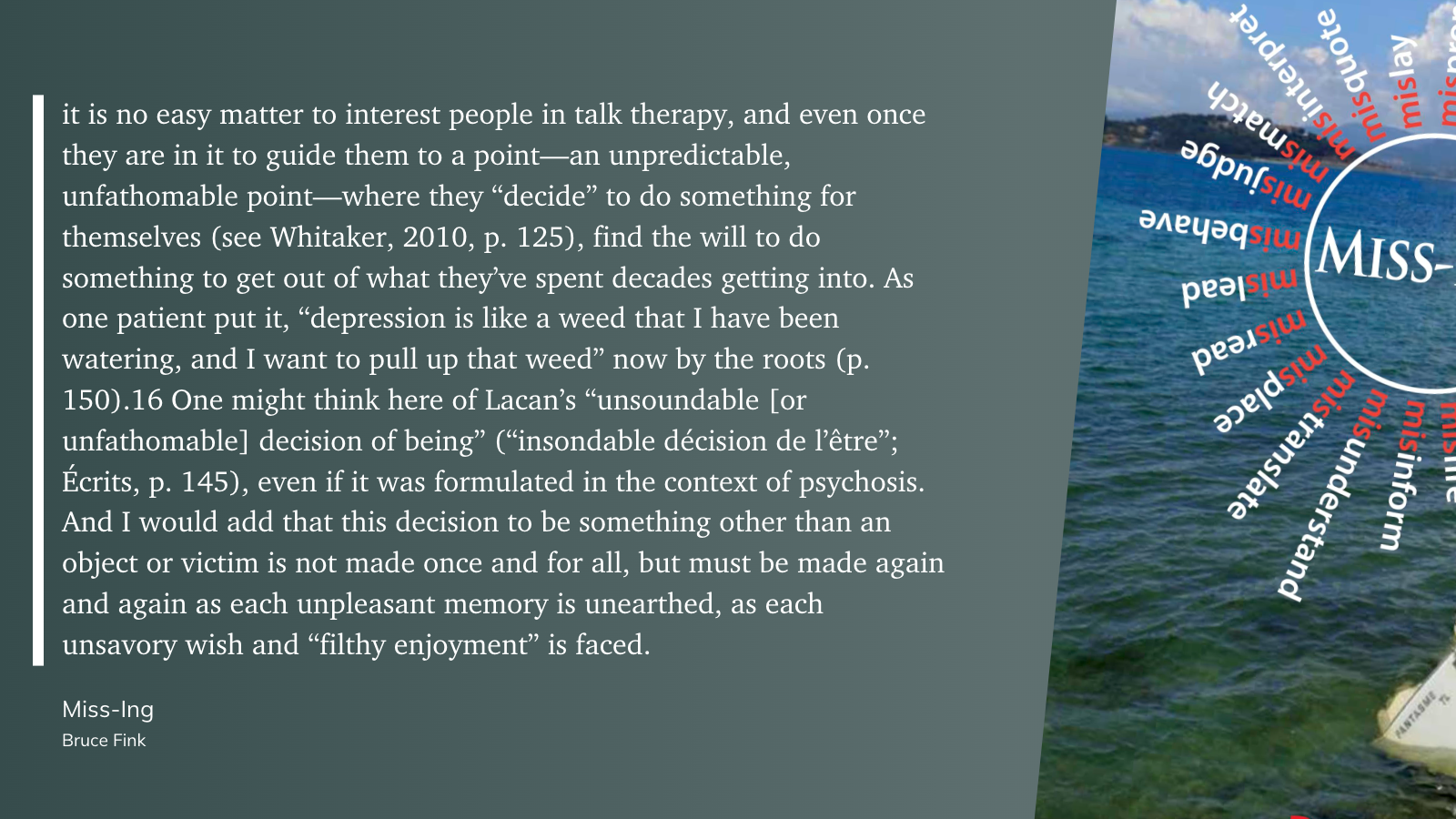
Particularly these passages from Bruce Fink:
By way of contrast, Lacan’s view is that losses are inevitable and irreversible, and they must be mourned. We mustn’t spend our whole lives complaining that we’ve been gypped and trying to get back what we feel we’ve lost out on. Now, once those losses are recognized for what they are and mourned, they can be sublimated or sublated in a sense, transmogrified with the coming to the fore of the phallic signifier, the Phallus with a capital P, symbolized by the matheme Φ. This is a forward-looking, as opposed to a backward-looking project. Rather than regressing to childhood to repair all the “damage” that was done, there is a push toward the recognition that what was, simply was what it was, it had to be that way (there is no point whining “If only things had been different….”); and a push toward the symbolization of something that can move things forward.
Bruce Fink, Lacan on Desire, loc 2379