I came across these delivery robots on Sunday morning, clustered in the corner of a park. One had been covered in graffiti, two had their flags snapped and a third one was covered in some strange green slime. It looked like Saturday night had been tough.
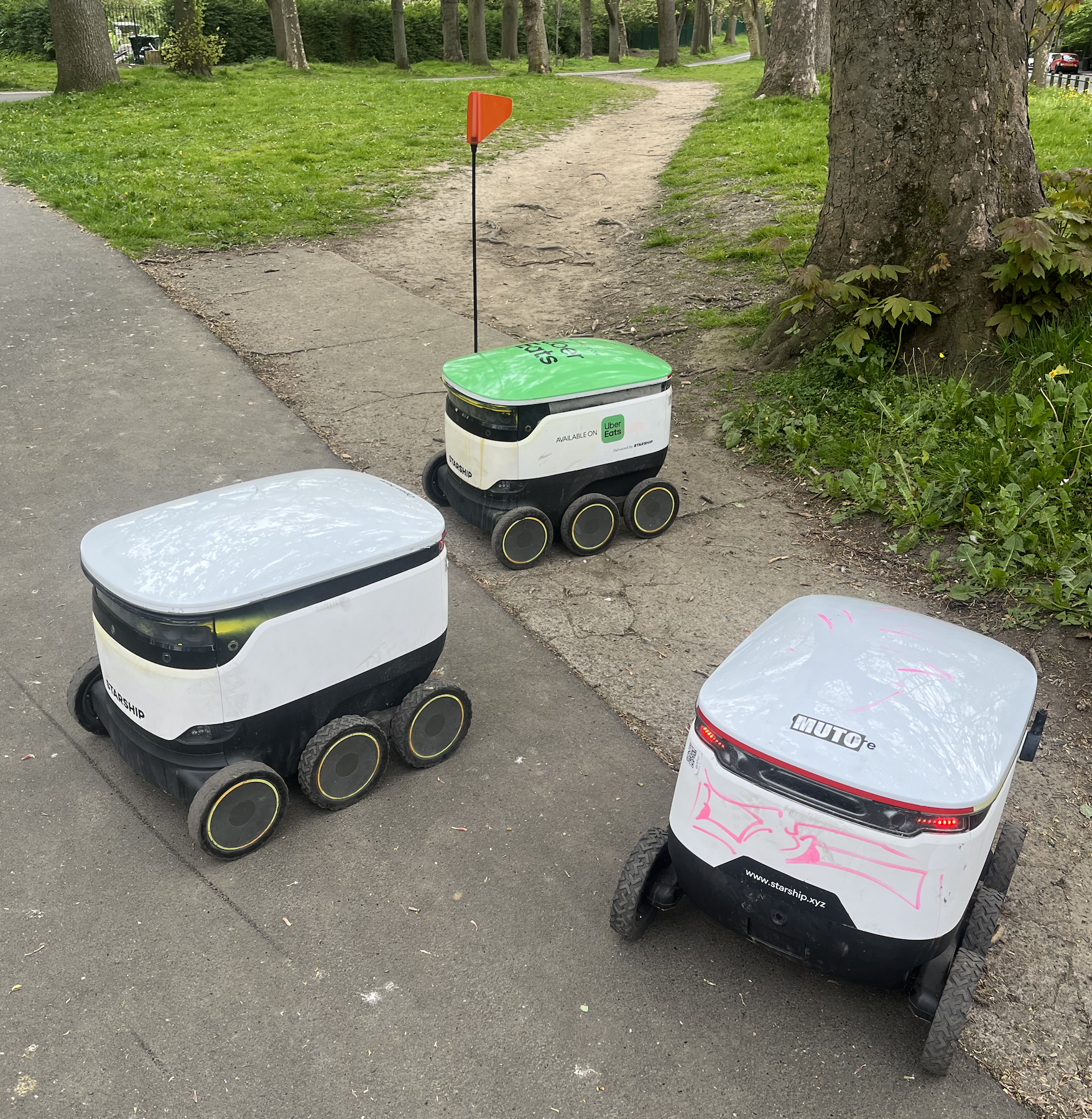
I find it hard not to anthropomorphise these robots. I heard the way they crossed the road described as ‘scrabbling’ yesterday and it’s the perfect adjective for how they appear to look left and right, before accelerating out into the traffic. People interact with them, talk about them, respond to them. In many ways the vandalism is the flip side of the anthromorphism. They are evocative objects in Sherry Turkle’s sense of provoking responses in the humans who encounter them. You might find them cute, you might have the impulse to cover them in graffiti, you might want to help them cross the road, you might want to block their path to see if they do.
The key thing is that they are evoking a response from you. If their design enables them to do that reliably then they are likely to be normalised, even if the economic model might not currently work in its current form. The real significance of them is how they become evocative features of the urban landscape and what that means for the political economy of the city.
It occurs to me that if we are projecting into these robots, which we clearly are because they obviously do not feel anything, it raises the question of what we are projecting. My hypothesis is that when I saw them on my run this morning, feeling sad about the vandalism and exhibiting a spatial sense of having retreated into a corner of the park, I was doing something with my own insufficiently acknowledged guilt about the gig economy. I’ve stopped using delivery platforms but I still end up taking Ubers regularly, even if I’m slowly tipping the balance to black caps.
When I feel vaguely sympathetic for these robots (while recognising how absurd that reaction is) am I expressing in an alienated form my own desire to demonstrate solidarity with gig workers, which is being subordinated to my own convenience in a way that provokes guilt in me?
I wanted to add that I think vandalism against delivery robots can be a political act. There are clear examples of this in vandalism against robo-taxis for example. I’m just not sure this particular vandalism can plausibly be read in those terms, though perhaps I’m wrong.

