
I was struck earlier by how frequently depressive breakcore producers are drawn to anime images in which something dark and foreboding emerges over the horizon, a solitary figure standing resolute as a metaphysical entity emerges through the clouds:
There’s something in these scenes which reminds me of Caspar David Friedrich’s visions of solitary figures held by the sublime:
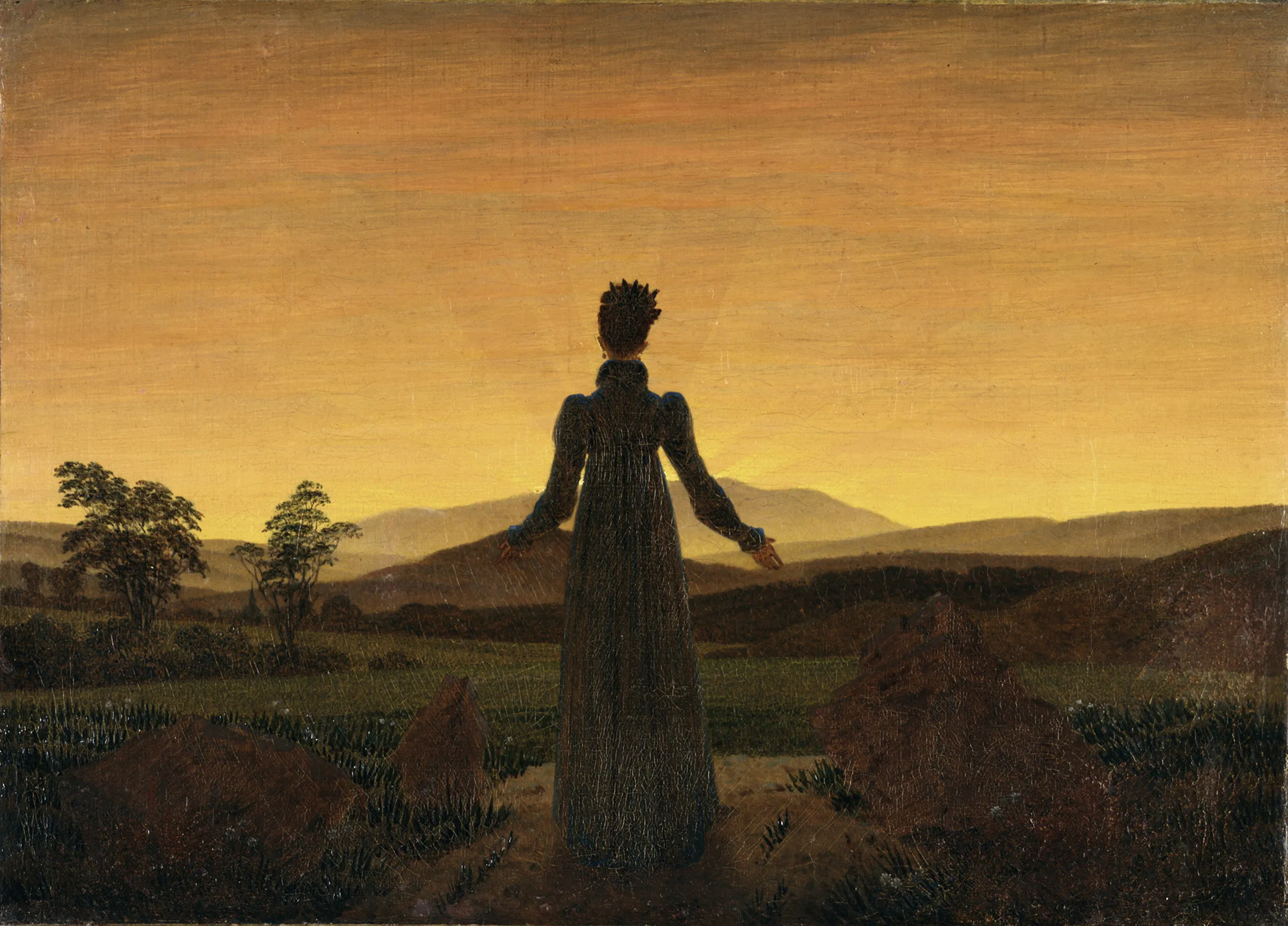
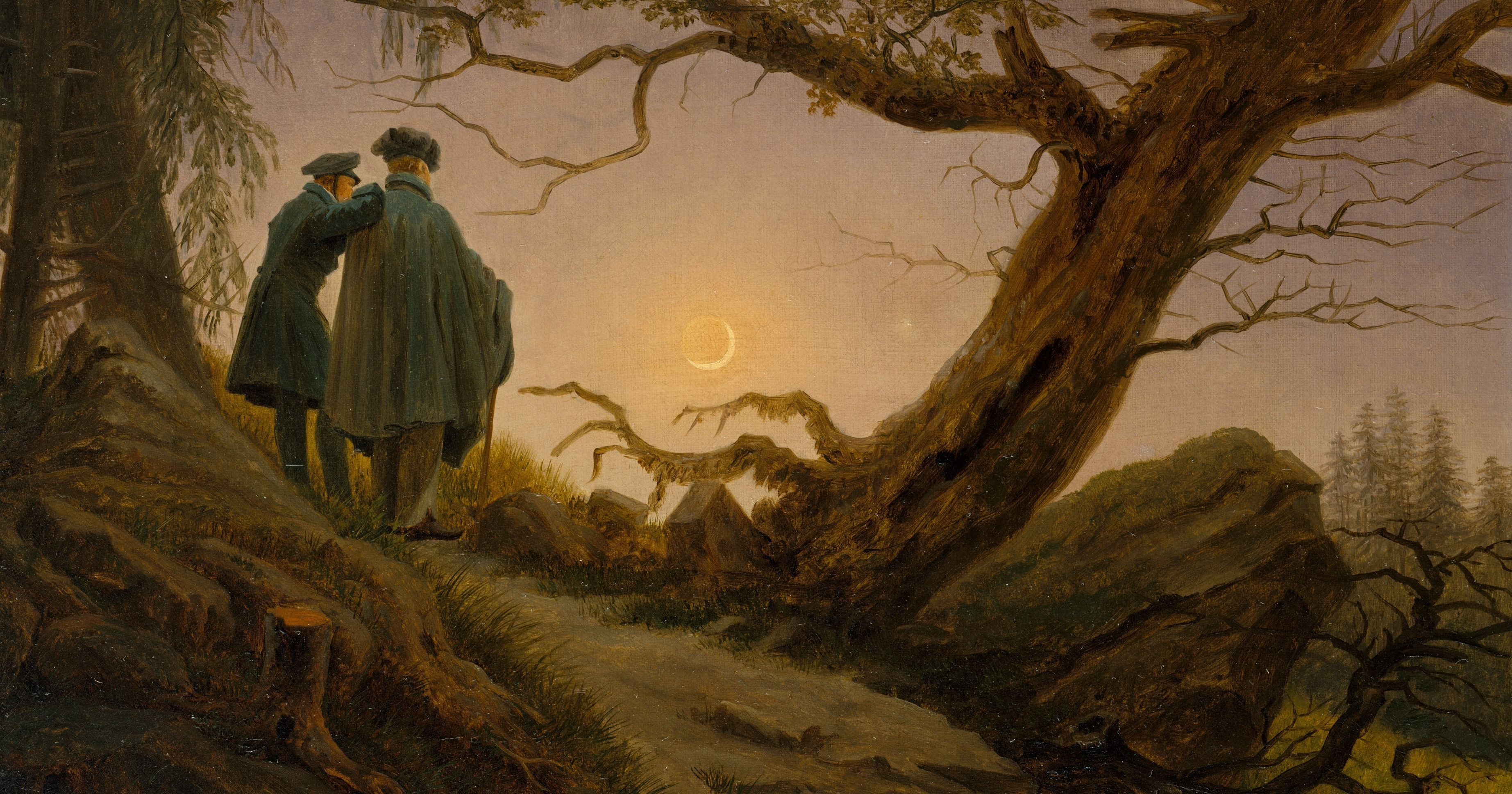
But in the case of these anime images there is something coming, whereas Friedrich’s images seem almost frozen in contrast. There is movement, rather than holding. There is a crack in the sublime which something utterly alien is emerging through. These are terrifying images in which the solitary figure is dwarfed by what stands before them but they are rarely scared or overwhelmed. Instead they stand waiting to encounter what is emerging, waiting to participate in the event that is taking place.
These images capture the mood of breakcore to me. I would argue breakcore can be seen as an expression of pure generativity: every other form of recorded sound serves as an interchangeable unit waiting to be broken up for potential reuse. But what could be a psychotic dissolution, meaning bleeding out as the integrity of the object world melts into nothingness, instead becomes an occasion for the most overpowering creative response. Everything can be put together with everything else. These things might not go together, they jar and clash with dramatic effect, but in the discordance emerges a deeper pattern, more subtle structures which link together the threads of what had dissolved into a new whole.
It leaves me thinking of breakcore as a combination of generativity and encounter, a dive into the metaphysics of semiosis which finds something Other lurking amidst the cacophony of the given. A sense that we’re getting closer to something through the pure embrace of our creative capacities, even if it remains unclear what that something is. Not in the Lovecraftian sense of Cthulhuic horrors lurking in the spaces between things, more what’s latent within our own meaning-making, and the stable object world within and through which we accomplish it.
I don’t experience this music as at all depressing, in fact it feels like it connects to everything I experience as most creative in myself.
I think this post was partly an (unconscious) attempt to understand why I found these lines by Charles Olson so powerful:
The end of something has a satisfaction
When the structures go, light
comes through
To begin again
Let the tower fall!
Where space is born
man has a beach to ground on
Let the tower fall! ✊
It’s only when the phallic structures of knowledge (‘this is what it is and nothing else‘) are allowed to fall that creation can really happen. It’s not a destruction of knowledge, even if it feels like a dissolution of meaning, but rather creating space for other modes of knowing. The encounter comes, I think, in recognising the integrity of what you cannot yet name. You sense there’s something there, even if you can’t say what it is. If you don’t let the tower fall, if you don’t let the rift open in the sublime, it’s impossible for that Other to reach you. It’s only through surrendering to the associative that it becomes possible to articulate the connections that you dimly sense beyond the clouds. At which point you realise that it’s not an Other at all but something infinitely weirder, which you can only gesture at even now you’ve found the words. Which in turn build another tower that will eventually have to fall.
 Mark Carrigan