
I argued yesterday that placing limits on your writing can help make it enjoyable. The physical act of writing is not in itself particularly time consuming. If you place limits on your writing then, as long as you’re also fuelling your creativity in various ways, you can focus on the literal act of writing before moving on to something else. I rarely spend time looking at a page that I’m struggling to add to. If the writing isn’t flowing then I move on to something else*, coming back to it at a later stage. I’ll explore the notion of ‘flow’ throughout this series (a recent book by Gloria Mark, described below, has left me needing to review what I think of this concept) but what I’m talking about here are effectively tactics for maximising flow in writing, even though I wouldn’t have previously put it that way. Writing is what Mihaly Csikszentmihalhi calls a “high challenge, high skill” task. As he describes it in Finding Flow loc 466:
When goals are clear, feedback relevant, and challenges and skills are in balance, attention becomes ordered and fully invested. Because of the total demand on psychic energy, a person in flow is completely focused. There is no space in consciousness for distracting thoughts, irrelevant feelings. Self-consciousness disappears, yet one feels stronger than usual. The sense of time is distorted: hours seem to pass by in minutes. When a person’s entire being is stretched in the full functioning of body and mind, whatever one does becomes worth doing for its own sake; living becomes its own justification. In the harmonious focusing of physical and psychic energy, life finally comes into its own.
Limits are a necessary but insufficient condition for reaching flow states. If you have all the time in the world, it’s difficult to sustain attention as “ordered and fully invested”. But if you have a clear goal, which you seek to accomplish within limits, flow states become possible. This is not sufficient to generate them but they become possible. What does this mean in practice? You sit down and you start writing, with the ideas pouring out onto the page in a more or less continual flow. The pace might vary, but the writing doesn’t cease. I experience this flow state with writing on a pretty much daily basis. It’s clearly one of the reasons I enjoy writing so much. It’s also one reason, as I’ll discuss in a future post, why writing centres me if I’m stressed out or unhappy in some way. But I can also only sustain it for an hour or so at the very most. When I have a ‘writing day’ I’m chaining these flow states together, giving myself enough time and space to move in and out of flow states over the course of the day. I’ve become a big fan of writing here 👇
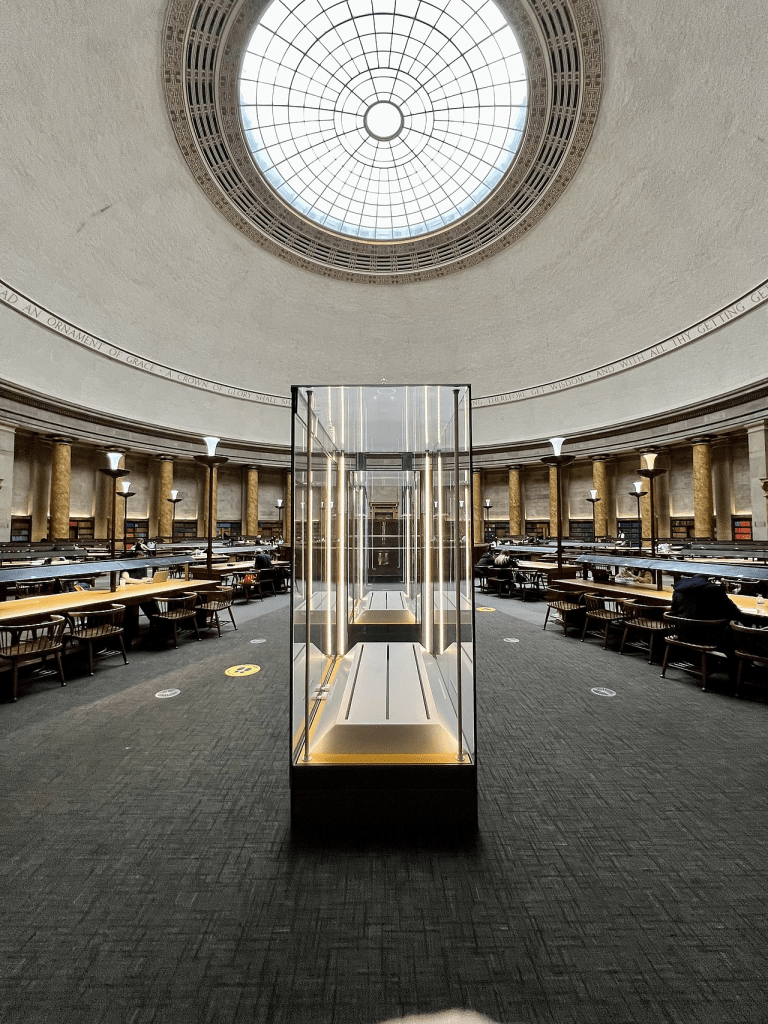
But if I’m in the library for a full day, I’ll probably spend four hours in the reading room max. In between these spells of intense writing, I’ll be reading downstairs, sitting in the cafe, seeing people, walking outside or even going up the road to see a film before coming back. I need the full day in order to chain together the periods of writing flow. But I would never expect that I’d spend the full day continuously writing. Why? Because I’d just exhaust myself staring at a screen feeling I should be writing when I’m not. There are lots of signs I’m falling out of a flow state: I start to get irritated by the people around me, I start checking the word count, I start thinking about other things I’m doing. Rather than fight that, I go with it and let myself switch into another way of relating to the world. I can always reliably come back to it at a later stage.
The only exception to the approach I’m describing here is getting started. It might be that I’m sleep deprived or preoccupied by something else. In this case I do try and force myself to get started if I’ve set it aside as a ‘writing day’. It’s increasingly hard to mark out this time, so I take it seriously when I do. But sometimes I just can’t meaningfully get started, in which case I try and hit a target of 1000 words and move on. If I’d two nights or more in a row of 6ish hours of sleep or less, I reliably lose the ability to enter a flow state. Before I gave up drinking, I’d notice that only a few drinks would often have the same effect the following day. My ability to enter flow states seems to track how my mind and body are doing in a way I find curious, which is a small but significant factor in changing how I relate to my own health as I trundle into my later 30s. It’s the point where, as we saw earlier, my “entire being is stretched in the full functioning of body and mind” and I take it seriously as a result. This means being realistic about how long you can sustain it and being respectful of how demanding, if enjoyable, it is to be immersed in this way.
*Even at points in time when deadlines are non-negotiable, such as the final stages of finishing a book, I do this within the project. I move onto a different chapter or I switch into an administrative tasks. What the psychologist Gloria Mark calls ‘rote activity’ can be weirdly recharging in these situations. As she describes it, rote activity “occupies the mind without using up much cognitive resources. Its easy engagement keeps people’s minds open while they put hard-to-solve problems aside, making room for new ideas to appear or half-baked ones to progress” (loc 2969). The point is to avoid staring at the page, castigating yourself for being unable to write. The fact I almost never do this is the flip side to flow in terms of explaining my enjoyment of writing: it’s reliably a positive experience rather than a negative one.
 Mark Carrigan
