
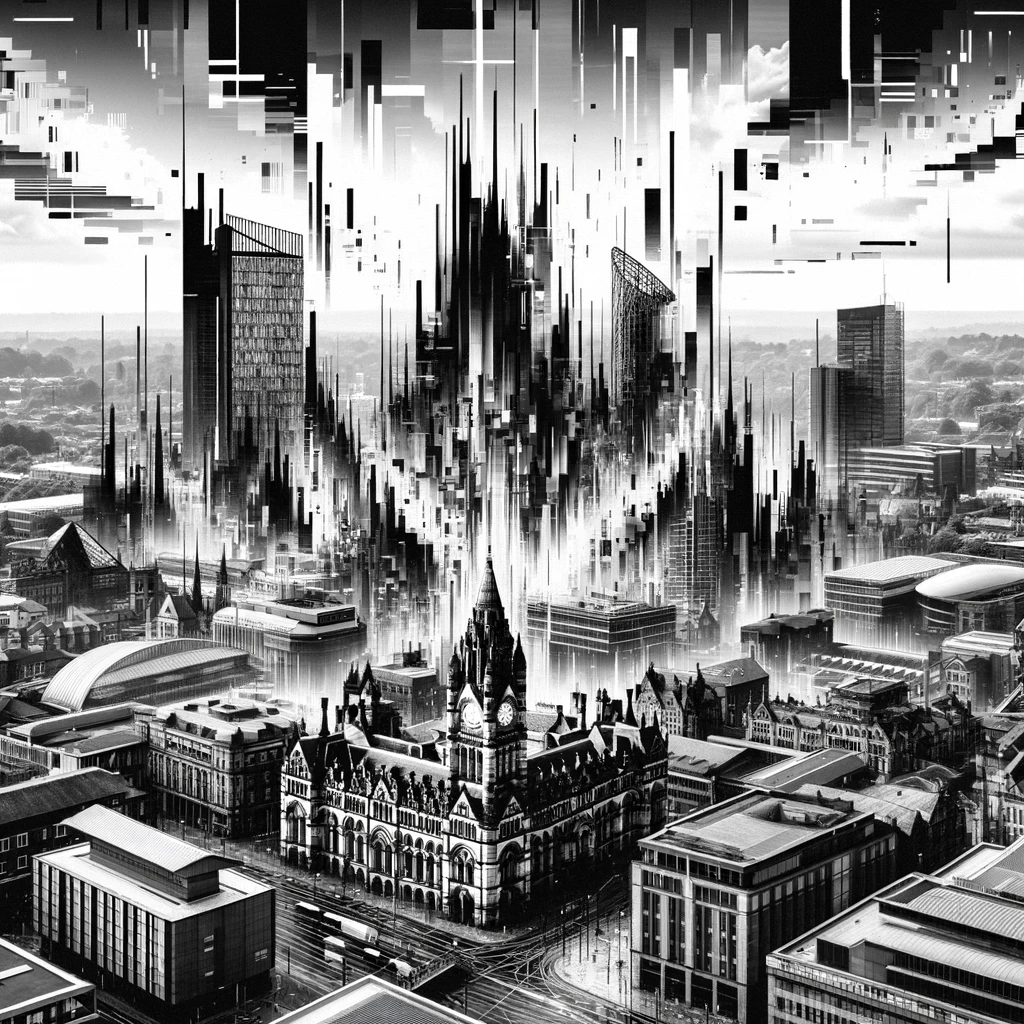
This was Claude 3’s response to this image I produced with DALL-E this morning:
In a world where the lines between reality and nightmare had long since blurred, there stood a city unlike any other. It was a place where towering skyscrapers pierced the eternally gray sky, their gothic spires and modern glass facades intertwined in a dizzying dance of architectural chaos. The city's name had been lost to time, but those who found themselves trapped within its labyrinthine streets simply called it "The Maze."

Amelia, a young woman with no memory of her past, woke up one day in the heart of The Maze. As she wandered the narrow alleys and cavernous avenues, she couldn't shake the feeling that something was deeply wrong. The city seemed to pulse with an unseen energy, and the few inhabitants she encountered seemed more like ghostly apparitions than living beings.

At the center of The Maze stood a grand, cathedral-like structure that seemed to call to Amelia. As she approached its ornate doors, she felt a strange sense of déjà vu, as if she had been there before. Inside, the cathedral was a kaleidoscope of stained glass and shifting shadows, and at its center stood an ancient altar.

As Amelia drew closer to the altar, the world around her began to flicker and glitch like a malfunctioning computer program. Suddenly, memories came flooding back to her - memories of a world beyond The Maze, a world where she had once lived a normal life. She realized that The Maze was not a physical place, but a digital prison, a simulated reality created to trap the minds of those who had dared to rebel against the oppressive regime that ruled the outside world.

With this knowledge, Amelia closed her eyes and focused all her willpower on breaking free from the simulation. The cathedral crumbled around her, the city's towers melting away into lines of code. When she opened her eyes again, she found herself back in the real world, surrounded by the concerned faces of her fellow rebels.

From that day forward, Amelia dedicated herself to fighting against the tyrannical government that had imprisoned her mind, determined to bring an end to their reign of control and to free all those still trapped within the digital nightmare of The Maze.
Here’s the intervening response to the question ‘what does this image convey to you?’, which I used to kick start the exercise, before asking for a story:
The image depicts a fantastical, almost dystopian cityscape. The buildings are dense, towering structures that seem to extend endlessly into the sky, creating a sense of verticality and oppressiveness. The architectural style is an eclectic mix of modern skyscrapers and older, gothic-inspired structures, giving the city an eerie, timeless quality.
The inverted black and white color scheme contributes to the unsettling atmosphere, transforming the city into an abstract, surreal landscape. The stark contrast and glitchy, digital-like distortions make it feel like a futuristic nightmare, a world that is both familiar and alien at the same time.
The composition draws the eye towards the center, where an ornate, cathedral-like building stands out among the monolithic towers. It suggests a city where old and new collide, where history and progress are locked in an uneasy coexistence.
Overall, the image conveys a sense of unease, a feeling of being lost in a vast, imposing urban labyrinth. It invites the viewer to imagine the stories and secrets hidden within this dark, twisted version of a city, and to ponder the implications of unchecked urban growth and technological advancement on the human experience.
I’m interested in where the Matrix-y cyberpunk genre was picked up from. Did that category emerge in the analysis of the image, or the idea of spinning a narrative out of the description?
 Mark Carrigan