

This is how the psychoanalyst Darian Leader contextualises L. S. Lowry’s Head of a Man (With Red Eyes):
The painter L. S. Lowry was caught up in a powerful relation of dependence with his demanding mother, and throughout his life he would say that everything he did had a meaning only for her. During her fatal illness, he found himself looking into his shaving mirror, seeing a strange face staring back at him. This alienation from his own image was experienced by Lowry as he painted a series of staring male heads during the same period. He would say that these heads ‘just happened’. Rather than being crafted with design, they just appeared on the canvas, and many years later he could still ask a visitor to his studio, ‘What do they mean?’ What connected Lowry to his body image, what made the image his own, was linked to his relation with his mother. As her sanctioning or condemning look threatened to disappear, so his own links to his body image evaporated. The place that his image occupied for her had changed, and so it lost its anchoring point. This renunciation of the image is rarely as literal as it was for Lowry, but the questioning of one’s identity can take other forms.
The New Black: Mourning, Melancholia and Depression, Loc 1897
With the imminent loss of his mother, Lowry found himself alienated from his image in relation to her gaze. The uncanny quality of the self-portrait expresses the breakdown of those familiar parameters: who is this person I now see in the mirror? For Lowry this series of male heads constituted, suggests Leader, a kind of anticipatory grief involving coming to terms with the loss of his mother’s gaze.
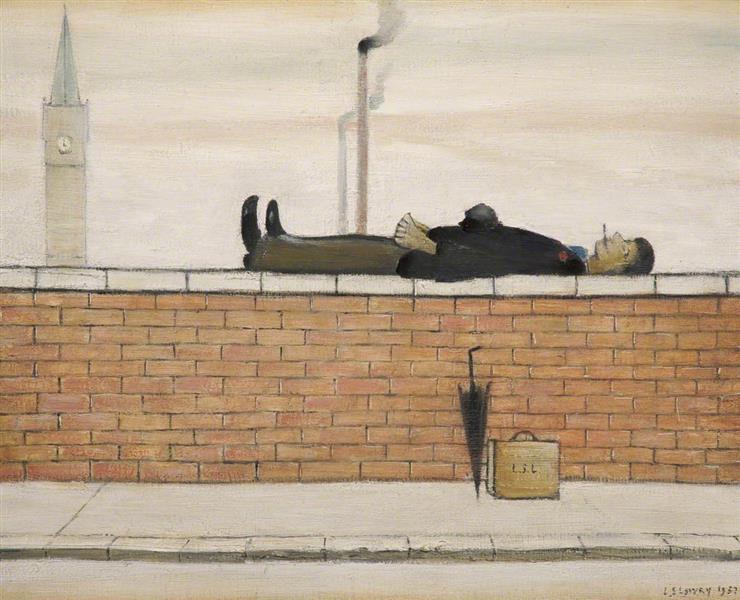
Contrast this with Man Lying On A Wall painted almost 20 years later. It also depicts Lowry (note the initials on the suitcase) but there’s a peace to this image, depicting the whole man comfortably immersed in a context reflecting something of his inner nature. It would be tempting to frame this as Lowry flourishing in the freedom from the constraints of the lost gaze, but the darker images he painted in his later life suggest a more complex relationship with women. Nonetheless there’s a comfort to the fact that Man Lying On A Wall came, if I remember correctly, after the period of his desolate sea scapes and the metaphysical emptiness they conveyed. Man Lying On A Wall makes me feel he eventually found an imaginary place for himself, located in the city yet removed from it, located in the nature of things yet immersed in what the pragmatists called musement.
 Mark Carrigan