
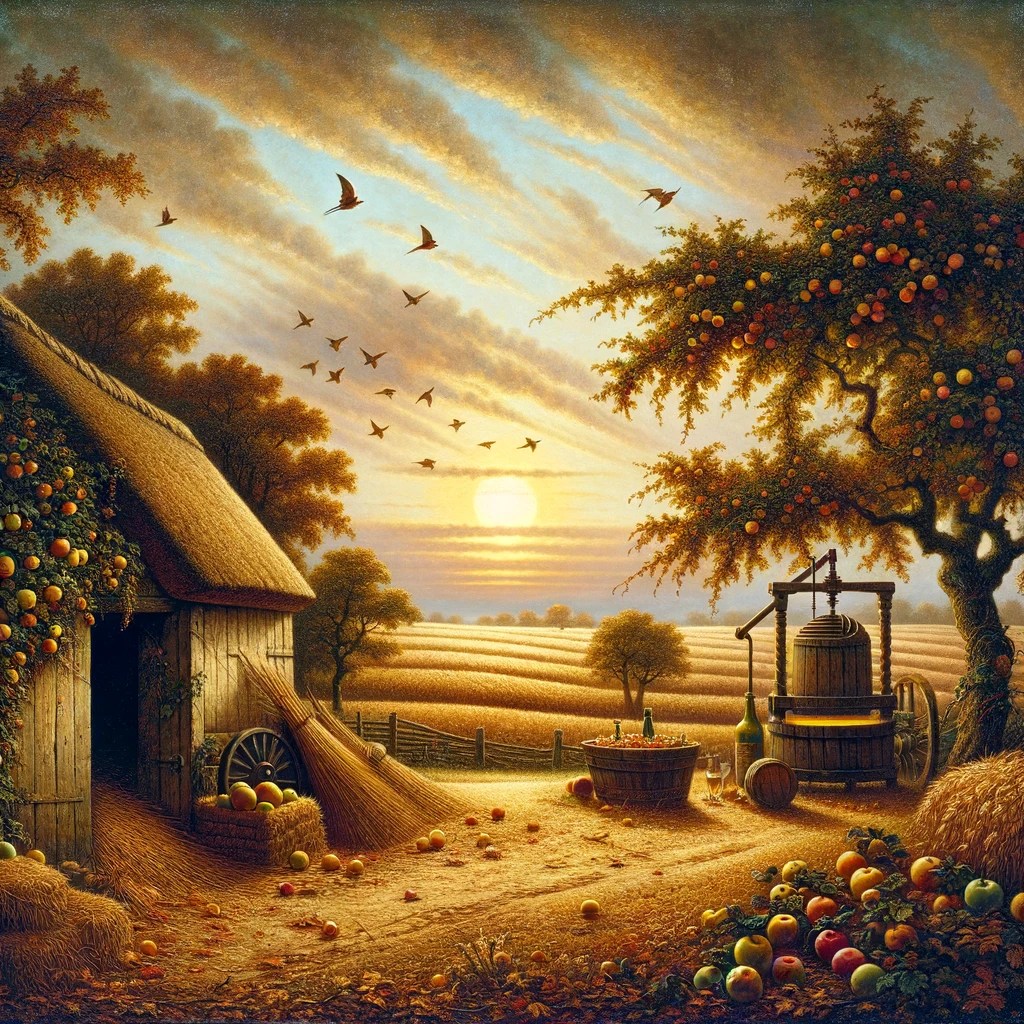
Season of mists and mellow fruitfulness,
  Close bosom-friend of the maturing sun;
Conspiring with him how to load and bless
  With fruit the vines that round the thatch-eves run;
To bend with apples the moss’d cottage-trees,
  And fill all fruit with ripeness to the core;
    To swell the gourd, and plump the hazel shells
  With a sweet kernel; to set budding more,
And still more, later flowers for the bees,
Until they think warm days will never cease,
    For summer has o’er-brimm’d their clammy cells.

Who hath not seen thee oft amid thy store?
  Sometimes whoever seeks abroad may find
Thee sitting careless on a granary floor,
  Thy hair soft-lifted by the winnowing wind;
Or on a half-reap’d furrow sound asleep,
  Drowsed with the fume of poppies, while thy hook
    Spares the next swath and all its twined flowers:
And sometimes like a gleaner thou dost keep
  Steady thy laden head across a brook;
  Or by a cider-press, with patient look,
    Thou watchest the last oozings, hours by hours.

Where are the songs of Spring? Ay, where are they?
  Think not of them, thou hast thy music too,—
While barred clouds bloom the soft-dying day,
  And touch the stubble-plains with rosy hue;
Then in a wailful choir the small gnats mourn
  Among the river sallows, borne aloft
    Or sinking as the light wind lives or dies;
And full-grown lambs loud bleat from hilly bourn;
  Hedge-crickets sing; and now with treble soft
  The redbreast whistles from a garden-croft,
    And gathering swallows twitter in the skies.

- To Autumn by John Keats
I came across this yesterday and I’ve had it reverberating in my mind over the course of a snowy, freezing day. It captures something comfortingly metaphysical about life and death, beginnings and endings, which I think is also present in this section of T.S. Eliot’s Little Gidding:
What we call the beginning is often the end
And to make and end is to make a beginning.
The end is where we start from. And every phrase
And sentence that is right (where every word is at home,
Taking its place to support the others,
The word neither diffident nor ostentatious,
An easy commerce of the old and the new,
The common word exact without vulgarity,
The formal word precise but not pedantic,
The complete consort dancing together)
Every phrase and every sentence is an end and a beginning,
Every poem an epitaph. And any action
Is a step to the block, to the fire, down the sea’s throat
Or to an illegible stone: and that is where we start.
We die with the dying:
See, they depart, and we go with them.
We are born with the dead:
See, they return, and bring us with them.
The moment of the rose and the moment of the yew-tree
Are of equal duration. A people without history
Is not redeemed from time, for history is a pattern
Of timeless moments. So, while the light fails
On a winter’s afternoon, in a secluded chapel
History is now and England.
 Mark Carrigan