
This might seem like an odd question to ask but it occurred to me when listening to the podcast Sounds Like a Cult. In a fascinating episode on the Landmark Forum (which I hadn’t realised was initially founded by Werner Erhard) they describe how the group provides “a new vocabulary” for people who “arrived broken … conceiving themselves and the world completely wrong”. The group provides “a brand new set of vocabulary words to help you reimagine yourself in the context of Landmark”.
It strikes me this is a characteristic which late capitalist communities tend to share with late capitalist cults, raising the provocative and difficult question of where and how we distinguish between them. What I mean by this is that emerging communities tend to be distributed based around people who have come together because of a shared search for something, motivated by a sense they couldn’t find it in the lifeworld they inhabited prior to that search. If you’ve felt wrong, different or rejected by the people in your life then an encounter with people who share that experience can be liberating. Being provided with a vocabulary which enables you to articulate previously negative experiences in a positive way can be transformative. There are lots of empirical examples of how this social mechanism can operate in a manner which is demonstrably constructive and makes a positive impact on the lives of previously stigmatised and isolated people.
This is why I’m so fascinated by examples where this is not the case. Perhaps we can talk about communities where it leads to the creation of what Archer and Donati call ‘relational goods’ which support the flourishing of members. We can talk about cults where it leads to ‘relational evils’ which lead to members being controlled and subordinated to someone else’s agenda. But it could be objected this is too neat and fails to grapple with the underlying question. What’s the difference between a cult and a community? Is a cult just a community we disapprove of or deem to be harmful? Or is there some deeper underlying difference we can identify?
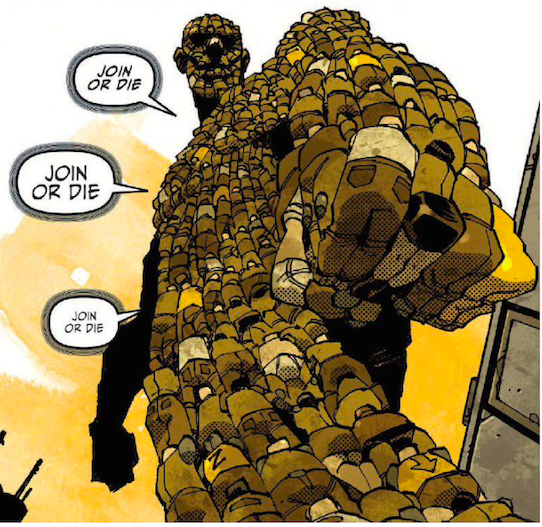
There clearly are cults which exercise a pernicious and destructive influence over their members. But there’s also a pervasive tendency within liberal thought to be deeply suspicious of any collectives, assuming that coming together as a group necessarily involves a sacrifice of autonomy. The image below from Judge Dredd volume 5 has always captured this for me as a visual metaphor. The assumption that collectives leave individuals with two options: joining or dying i.e. you can either subordinate yourself into the group or be destroyed by the group.
There’s something deeply impoverished about what this suggests for relational life. It’s tone deaf to the immensely wide range of ways in which we can participate in groups, the literal meaning of which is to partake in as Chris Kelty points out in his book The Participant. There’s almost a paranoia about collectives and a fear we will find ourselves consumed by them if we let our guard down for even a moment. There’s a profound failure to recognise the personalist insight that we express our individuality in our collective belonging. This relational approach makes it easier to distinguish between cults and communities. In the former we sacrifice our individuality but in the latter we more fully become who we are through who ‘we’ become with others.
This might still be too neat but it at least gestures towards an ontological answer to this question. My suggestion is that a liberal social ontology will always struggle to draw the distinction between cults and communities in an adequate way, leading to a fundamentally expressive delineation in which this is simply a matter of personal judgement. This is obviously problematic, particularly given what seems to be a greater propensity for platformised socialisation and the epistemological chaos of platform capitalism to produce both cults and communities. People cling together in pursuit of certainty but they’re also forced to adopt a more intentional approach to coming together because social life is less able to reliably produce commonalities and solidarities through the sustained juxtaposition of lives in time and space.
 Mark Carrigan