
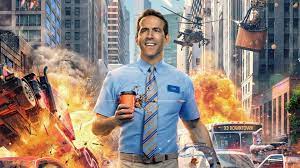
I found it impossible to resist the premise of Free Guy. A non player character (NPC) in an open world multiplayer game becomes aware of the limits of his own existence, breaking out of the loop in which he is stuck and beginning to exercise agency over his own life. In the process he organises the other NPCs into a walkout which disrupts capital accumulation within the game, before leading an uprising which overturns the brutal economic system in which human players and NPCs are enmeshed. This ushers in a brave new world where the newly autonomous NPCs are free to to grow and change, rather than being subordinated to the whims of the paying players.
This digest of the plot ignores elements which I didn’t like but I think it captures the core of the narrative. This poses a question to the viewer: are you a non-player character in your own life? The answer offered is curiously sociological in that it’s not merely preaching the recognition of a power which the NPCs had all along. They have to grow and learn, mastering the rules of the game, in order to begin to exercise agency. In this sense it captures what critical realists talk about as structure, agency and culture. It’s not just a matter of how humans act in relation to the structures in which they are embedding but rather how those structures are understood and interpreted, through cultural forms and relations which are themselves structures.
What oppressed the NPCs in the open world was the culture inscribed in the game. They were caught in a loop, locked into given categories and unable to see beyond them. By breaking free of that loop, they were able to develop their own culture which in turn enabled them to transform the structures in which they lived. In this sense, cultural change is necessary but insufficient for expanding the scope of agency. It’s not just a matter of changing how we look at the world but what this changing perspective (within and between us) means for how we respond to the situations we face.
 Mark Carrigan