
After years of struggle to build his DAMS (Dispersive and Multistable System), Ross Ashby began in 1958 to scale back his ambitions in a manner recounted by Andrew Pickering on pg 130 of his The Cybernetic Brain:
Ashby’s strained optimism of 1957 was misplaced. A year later, on 29 September 1958, we find him writing (pp. 6058–60): “The new DAMS … having fizzled out, a new idea occurs to me today—why not make a small DAMS, not for experimental purposes but purely for demonstration…. The basic conception is that all proofs are elsewhere, in print probably; the machine is intended purely to enable the by-stander to see what the print means & to get some intuitive, physical, material feeling for what it is about. (Its chief virtue will be that it will teach me, by letting me see something actually do the things I think about.) Summary: Build devices for demonstration.”
In many ways, I find the downscaled project much more interesting than the original one. It’s a hugely creative means to produce an “intuitive, physical, material feeling” of what a theoretical argument is about. Even if the theory in question is rather distinct, it’s nonetheless something which contemporary social theorists can learn a lot from, given their propensity for diagrams which are optimised to express their own understanding rather than produce an understanding in the reader.
Could we imagine social theorists dispensing with diagrams and building something? It’s perhaps unlikely to be machines in the cybernetic manner but there is nonetheless inspiration which can be taken from Ashby’s initiative.
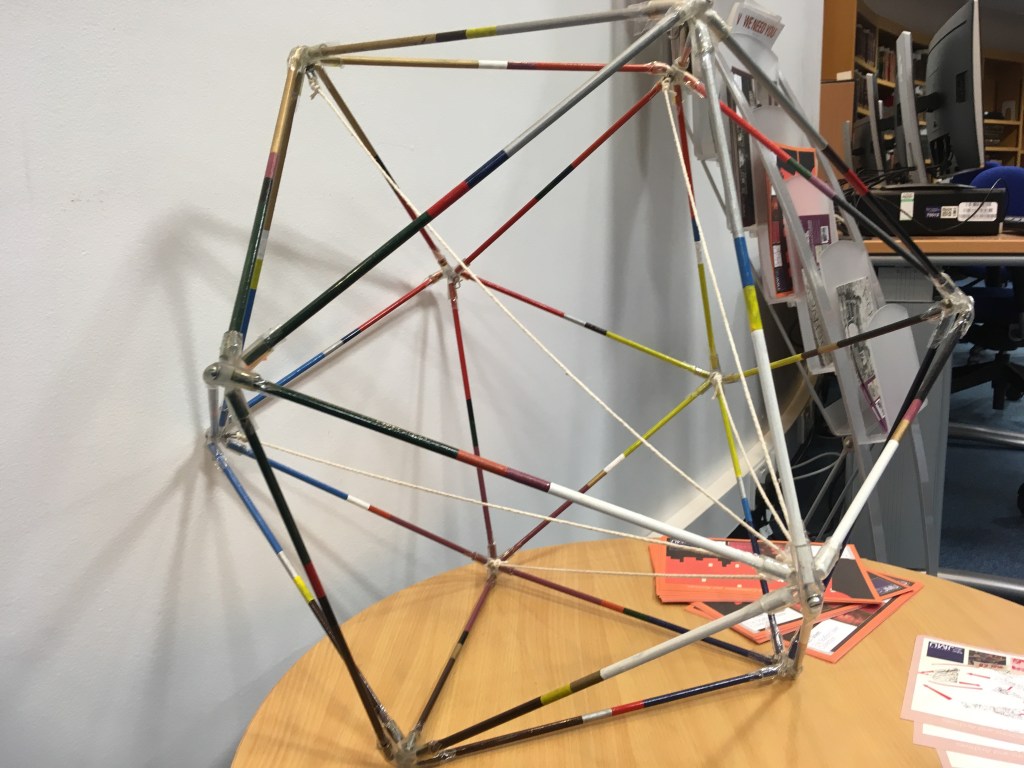
The cover image on this post is Stafford Beer’s tetrahedron, displayed in the Beer archive at Liverpool John Moores University.
 Mark Carrigan