
I came across the following extract in the Stafford Beer archive at Liverpool John Moores University. It is from a letter which Beer writes to his children, offering insights into the character of existence as a Christmas present to them. His use of the term poise caught my attention. I first used the term poise in a masters dissertation investigating the agency of LGBTQ youth in their negotiation of sexual normativity. I wasn’t entirely sure what I meant by it then and I’m still not certain now, in spite of it being a category which my thinking often comes back to.
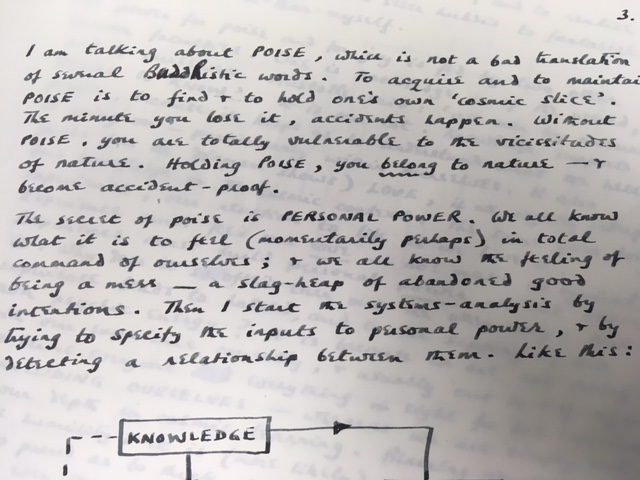
By poise I’ve tended to mean something akin to a skilful and confident embrace of change. It connects to an observation Helen Kara made about changing tempos. Her experience resonated with me and it’s precisely in those moments of change when I often feel I lack poise, unravelling slightly and having to reassemble myself in order to cope with the change underway. But there’s much more to it than that, albeit in a way I’m still struggling to articulate. It’s too early in my encounter with Stafford Beer to know if he means poise in the same way. Nonetheless the focus on feeling in command of oneself in a way that renders one less susceptible to the vicissitudes of nature certainly rings a bell. To have poise is not quite to retain your shape through change, as much as exercise a second-order control over the change that is underway.
Perhaps as Beer puts it, it’s a matter of holding on to your cosmic slice. This idea makes me think of the Deleuzian notion of lines of flight. If we conceive of this as an object of our own awareness, a sense of our own becoming in the world lurking at the heart of all life’s mysteries, poise is a capacity to take ownership of our line of flight. Not in the sense of control but in the sense of steering, made richer by contingency and more elaborate by uncertainty. Cultivating poise is not sufficient for human flourishing but I suspect it is necessary.
 Mark Carrigan