
At the end of last week, I attended a really thought provoking workshop at Bath university on Digital Qualitative Research. It was organised by Phil Brooker and Dina Vasileiou, both based at Bath, inviting a really interestingly diverse range of people (theorists, qualitative researchers, commercial social researchers, computer scientists, HCI researchers and software developers) to discuss the challenges entailed by qualitative digital research and to discuss how existing software could be changed or new software developed to meet these needs.
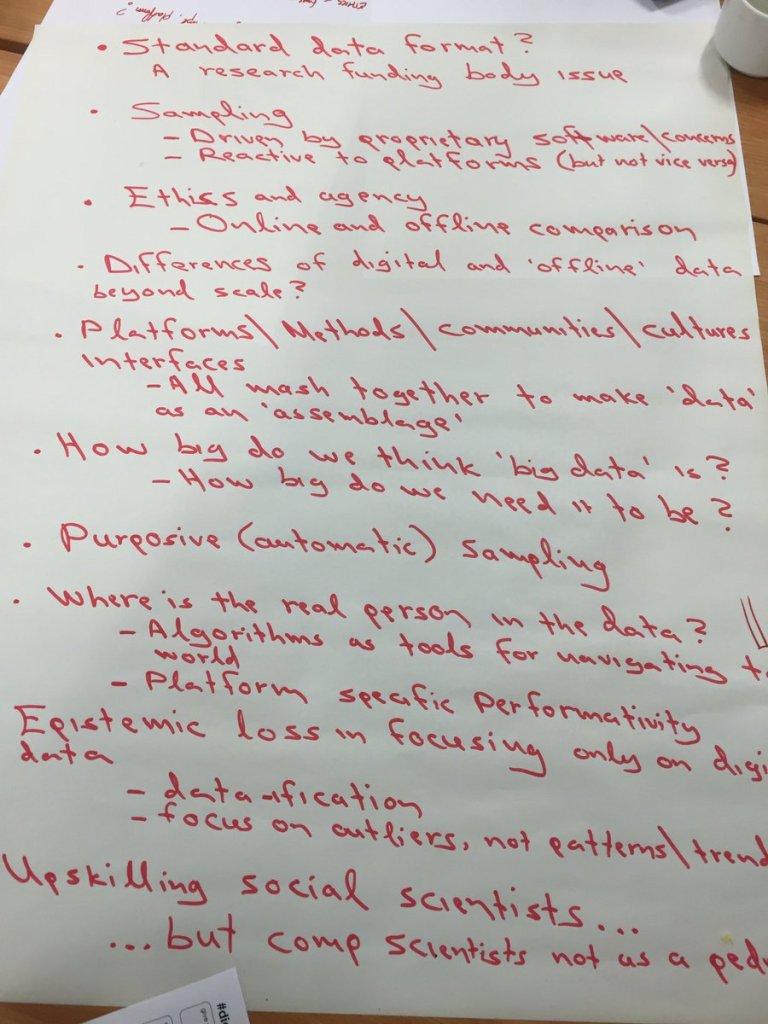
These are the ideas and problems we compiled as a group which structured the subsequent workshop:
These are my scrawled notes on the discussion I had with smaller groups:
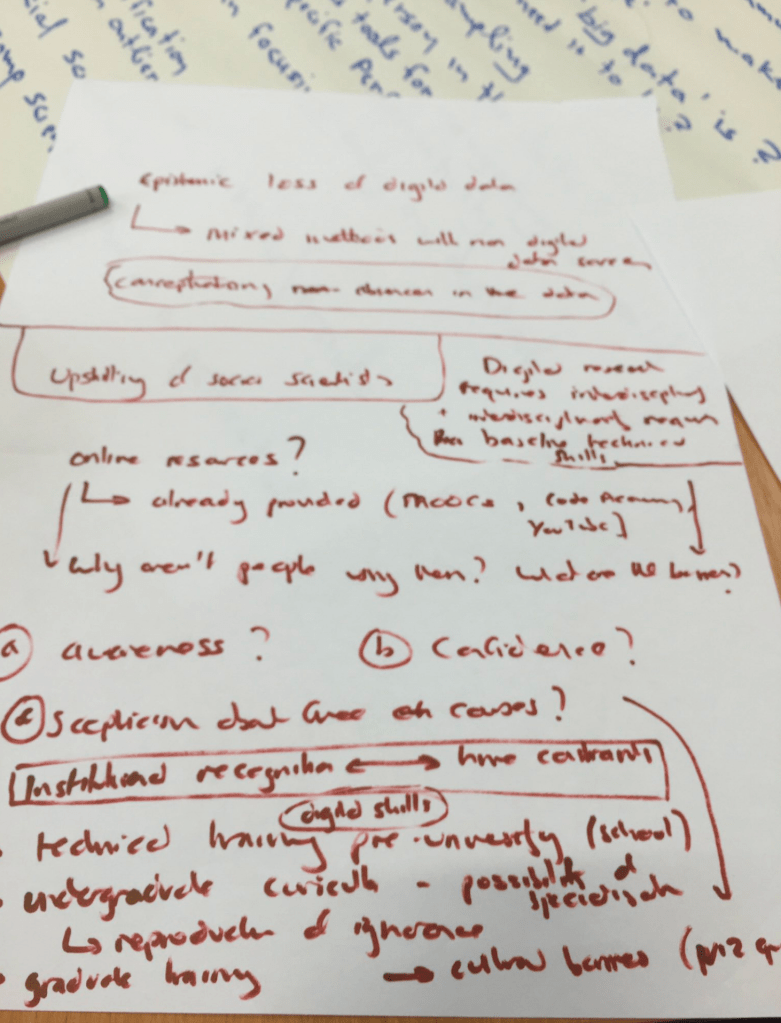

We had some fascinating discussions about the necessity of ‘up-skilling social scientists’ for digital research but doing so in a way which avoids lionising and imitating computer science. This raises the obvious question for me though, as to what digital qualitative research is for: what are we seeking to preserve and why? What’s lost if we lose a qualitative perspective in digital social research? My instinct here is to go back to interpretation, to argue for the irreducibility of the interpretive dimension of social life. To go back to a critique of behaviourism and a critique of positivism, both of which are currently being rearticulated in complex and interconnected ways, but to develop these as part of a methodological engagement with the dazzling array of social scientific opportunities that digital research is opening up. Theory should be at the heart of Digital Social Science, but not theory for theory’s sake.
 Mark Carrigan