
I went to see an excellent exhibition about children’s television yesterday afternoon, intended to explore “how the magical programmes of our childhood have created memories and nostalgia in adults and children alike”. The possibility of such explanation presupposes some degree of collectivity. The exhibition was ambiguous at points but there was a clear undercurrent of ‘our memories’ informing the curation, something which was particularly pronounced for me given I was seeing it with a Polish friend for whom many of these were not her memories. It would be possible to interpret such shared cultural reference points as collective memories or collective horizons, albeit ones delineable by age cohort, but it occurred to me that we could more usefully read this in terms of temporality and routine. This snippet stood out to me yesterday and I’ve been thinking about it since:
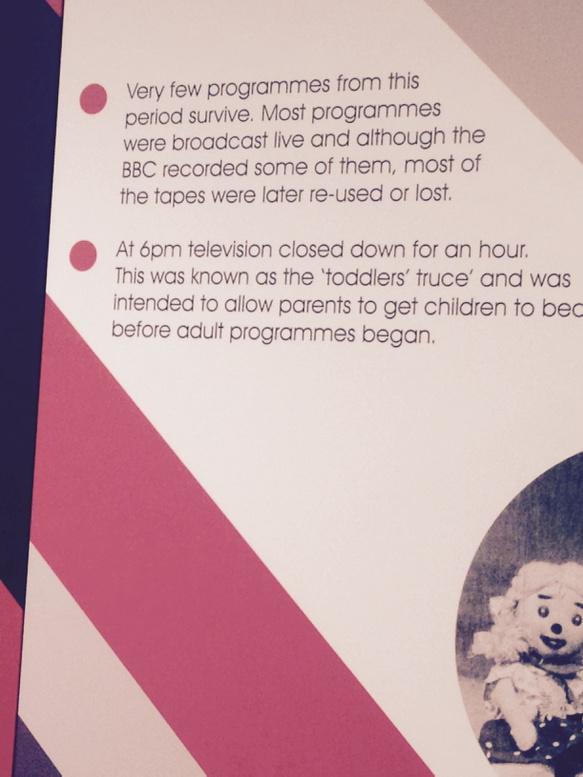
This degree of synchronisation, perhaps itself dependent upon a long discarded Reithian vision, seems jarringly anachronistic in retrospect. But it’s also much easier to recognise it empirically than is the case for contemporary routines of cultural consumption and the aggregate patterns they produce in wider social life. I’m not just talking about ‘our’ having watched the same television at the same time, but rather that ‘same time’ as being embedded in a broader cluster of routines which constitute the texture of everyday life.
To be clear: I’m not suggesting that the existence of the “toddler’s truce” necessarily brought about its supposed effect. Nor that cultural consumption, or its highly synchronised and normatively charged absence from 6pm to 7pm, necessarily anchored routines or was even a particularly significant component of them. But it’s left me thinking about how temporal structures can be used to understand cultural memory, as well as how these are both facilitated by but also work to encourage clusters of everyday routines which will, at least as a whole, contribute over time to the constitution of the people who are leading them.
 Mark Carrigan