
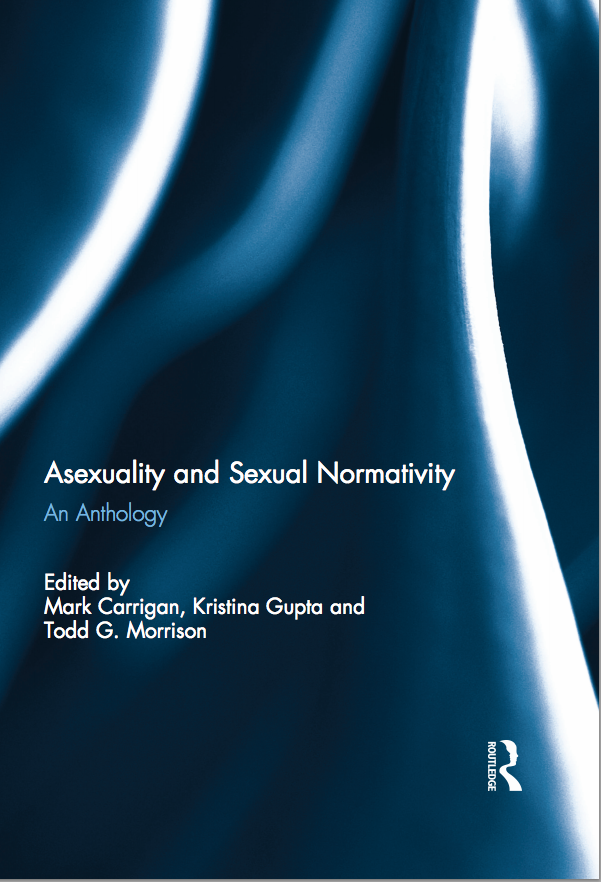
I was initially excited when Taylor & Francis suggested that Kristina Gupta, Todd Morrison and I extend the journal special issue that we published on asexuality into an edited collection. However my excitement was rather dashed when I found out the book was going to be £85. While it was still an improvement on the £125 price tag attached to the first book I edited, it was nonetheless somewhat deflating and I’ve felt a bit ambivalent about the project since then. So it was very nice to see the book receive a lovely review on the LSE Review of Books.
I’ve attached some extracts below. It’s particularly nice that the reviewer recognised what I was trying to do when choosing how to extend the original special issue (frame asexuality in terms of broader historical issues of sexual normativity) and seems to have derived a lot from this intellectually. I don’t see why anyone would ever buy a copy of this book for themselves but please do recommend that your university library buys it! An awful lot of work went into this volume and it would be rather depressing if no one ever reads it because of the price tag.
Discussion about asexuality has been on the rise since 2010 and there are quite a few collections of articles that have attempted to define asexuality as a movement within and out of the margins of sexual normativity. Compiled by academics and smartly divided into chapters, the present collection of research articles endeavors to explore the obscure issue of asexuality as a social construct, an alternative (non) expression of desire, and, interestingly enough, a parallel political path. Painstakingly collected statistical evidence is provided in many of the articles, and it is this evidence which runs in perfect harmony with Michel Foucault and Judith Butler’s more theoretical concept of gender as a socially constructed identity which the average person needs to perform on a daily basis in order to fit in a given social norm.
The importance of late eighteenth-early nineteenth century thought is particularly emphasized, and rightly so, since that time saw the emergence of the discourse of the “normal,” a discourse that was contested by Foucauldian criticism a few centuries later. Some articles, such as “Sex as a normalizing technology: early-twentieth-century public sex education campaigns” (p. 82) and “The average and the normal in nineteenth-century French medical discourse” (p. 95) touch on various moments in history and relate them to the normalizing discourse of sexual expression; this is particularly crucial in telling the story of asexuality and in realizing why it has been narrativized as deviation from the norm. Historicising asexuality in such a manner sheds light on its current social reception within cemented norms.
[….]
The most significant feat of the present collection of articles is that it consistently emphasizes, as a whole, the metanarrative of abnormality and the arbitrary division between sexual normativity and sexual pathology. Although some of the articles focus on detailed accounts of case studies, the structure of each chapter helps the reader navigate around the complex issue of asexuality, focusing on different elements—i.e instruments, research methods, results—according to interest. Admittedly, some parts of the book are perhaps too focused in theoretical and academic research; having said that, though, each and every one of the articles truly contributes to the disambiguation of the notion of asexuality in the present, and is work scrupulously filtered through numerous sources.
 Mark Carrigan