
These are some notes I’ll be adding to as the project on social movements I’m working on with Tom Brock develops. Initially they’re aiming towards the revision of a paper and chapter we’ve written (as well as the conference paper we’re giving in a few days time) but we also have a much bigger project in mind, albeit one that will require an intimidating amount of reading before it can ever see the light of day. Given my growing inability to work out what I think about something I’ve read without blogging about it, I thought that some online notes would be a pretty helpful way of getting started. These notes will be my attempt to build upon the conversations Tom and I are having in order to elaborate upon our project and clarify what I think about the social movements studies literature I’m beginning to work my way through.
One key aspect of what we’re trying to do concerns the reoccurring conceptual dichotomies of individuals and groups. We want to overcome this dichotomy but do so on in a way that resists the temptation to subsume these categorical distinctions into the study of networks. It doesn’t follow from the demonstrably fuzzy character of the boundaries of social movements that they have no status beyond being a construct of the analyst or a collective identity shared by diffuse networks which have undergone a process of mobilisation. We propose to start at the level of social ontology because we think that these underlying ontological questions inevitably inform the methodological ones which guide empirical analysis.
While we agree that, as Gemma Edwards (2014: 142) puts it in her discussion of Melucci’s work, “Constructing a sense of ‘we’ who are against ‘them’ in a conflict over ‘this’, is what social movements have to do in order to be effective at mobilization” (Edwards 2014: 142) we disagree about the understanding of collective identity invoked here. In fact the notion of ‘collective identity’ seems problematic in itself when it is invoked to explain how individuals coalesce into a wider movement. In this sense engaging with Melucci’s work will be crucial to developing our argument. But we think that what seems to be, in work influenced by Melucci and beyond it, a tendency to invoke collective identity can better be explained in terms of a converging evaluative orientation towards relational goods which emerge through situated interaction. As well as Melucci, it will also be important for us to engage with Blumer because, in spite of the problems with collective behaviour theory, we want to argue that events are crucial sites through which social movements are (re)constituted – this may be reproductive (mundane meetings, social events, shared logistical work) and it may be transformative (demonstrations, occupations, encampments).
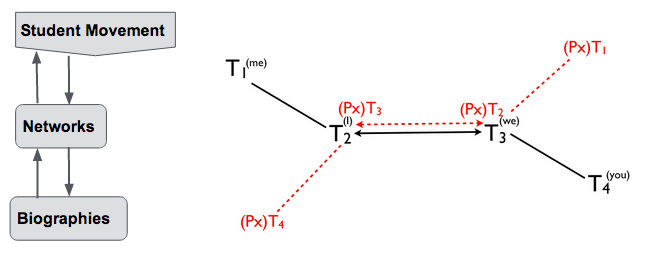
What our approach is orientated towards is registering three distinct dimensions of change (biographies, networks and movements) as well as the role they play in reproducing or changing the internal structure of the social movement. In doing so, we recognise the way in which other social agents can influence the composition of the movement through their effects on individuals, networks or the movement as a whole. The basis of our approach is to look to processes pertaining to networks and individuals, understanding the former to be constituted through the interactions of the latter within a situated milieu (t2-t3), with emergent consequences for individuals and the network of relations obtaining between them (t4). In using this morphogenetic approach, in which the t4 of one cycle is understood to constitute the t1 of another cycle, we attempt to disengage the different features of dynamic processes in a way that respects their dynamism. The exercise is not intended to offer a total theory of a social movement but rather constitute a methodology for the analysis of qualitative data which can help us understand the changes undergone by the informal networks (and the related individuals out of which they are composed) in a way that can be incorporated productively into realist sociology. We’re trying to retrieve the ‘on the ground’ situation, not as an ethnographic addendum, but rather because we think that the ‘grouping and regrouping’ of agency which defines what Archer calls the double morphogenesis needs to be understood in terms of processes arising from its internal constitution as well as those processes arising from the action of the social agent as a collective acting in relation to other collectives and subject to the consequences of those actions as well as the unintended consequences of the broader struggle.
However unless there’s a practical pay off to this abstraction then it’s of questionable value. That’s why the third aspect of our project is likely to be the most time consuming. We want to engage in a series of case studies, likely to be dependent on secondary data unless we can get funding – though we engaged in a digital ethnography (albeit of a rather informal and truncated sort) for our student movements paper – in which we analyse contemporary social movements and make a case for the explanatory gain that ensues from applying this realist theory of social movements.
So this is what I think the project will entail in practice. Note that I’ve switched from ‘we’ to ‘I’ here because I’m newly aware of quite how time consuming what I’m proposing will be:
- Critical engagement with existing traditions within social movement theory relating to individuals, networks and collective agents.
- Developing an account of the morphogenesis of social movements which builds on Archer’s morphogenetic approach, Archer and Donati’s relational realism and my PhD work on personal morphogenesis.
- Elaborating upon the approach through a series of detailed case studies of contemporary social movements.
These notes will likely only extend to the first part of the project. However I’m hoping they’ll be a useful resource for me to consult in later stages of the project, as well as an opportunity for anyone interested in social movement theory to argue with me about my interpretation of the author’s I’m engaging with. In a way social movements are what I always wanted to study most, though didn’t for rather convoluted reasons, so it’s exciting to get started. Much of my interest stems from the way I realise that I’ve been changed by my participation in social movements (particularly the anti-war movement in my late teens and my two stints in anarchist organisations of very different sorts) and it’s this aspect of social movements that I hope we can incorporate into this developing theoretical approach.
 Mark Carrigan