
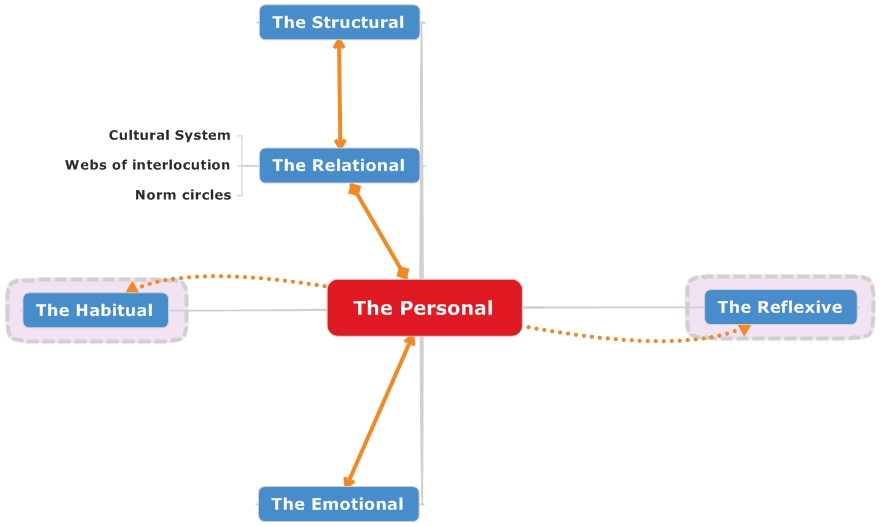
 This is a second attempt to visually represent the ontology I’m working within in my PhD research. One of my key aims is to try and offer an emergent account of psychobiography, able to capture the complex multidimensional causality which shapes a particular person’s unfolding biographical trajectory.
The top half of the diagram represents the interpersonal. The individual always finds themselves enmeshed in a relation web, reproducing and transforming it as they exercise their human agency over time. Structural influences are partially mediated through these webs in so for as that social structures always emerge from specific groups of people. As Elder-Vass (2010: 86) puts it, ‘to the extent that it refers to something genuinely causally effective, the concept of social structure refers to the causal powers of specific social groups’. Cultural influences are again mediated through the relational without being reproducible to it: the normative influences of specific groups pertinent to our lives (norm circles), the interlocutors we turn to in assisting our internal deliberations and the propositional content of the items we encounter through our participation in propositional culture.
The bottom half of the diagram represents the intrapersonal. The interplay between habit and deliberation in the exercise of human agency: all our deliberations take place within a psychological context of action (our habitual dispositions, our habitual conceptual frames and our emotional array) which in turns serves to reproduce or transform that context within which future deliberation will occur (personal morphogenesis). Our habits are, in part, the sedimentation of past deliberations. Similarly the parallel interplay between emotion and deliberation: our emotional array serves as the background to our deliberations (and often serves as the prompt to them) but is in turn transformed by them (personal morphogenesis). Our emotional array stands as the precondition for deliberation (without our emotions the options wouldn’t mean anything) but its also a consequence of them.
This is a very rough sketch of what I’m trying to argue because this is still proving difficult. I’ve used a realist ontology as a starting point (particularly drawing on the work of Archer and Elder-Vass) but, as Elder-Vass himself suggests, ontology should be developed through an iterative engagement with the data. Does isolating these domains and the causal relationships (morphogenesis and morphostasis) pertaining between them help me understand the causal processes represented in my interviews? The filled lines stand as such causal relationships between domains – both upward and downward.
What makes this so complex is the manner in which causal relationships can be traced among multiple domains: e.g. a stable, well paid and high status job (structural) facilitates the stable reproduction of ongoing family life (relational) which poses few new emotional problems for the child (personal) facilitating a fairly stable and uneventful emotional life (emotional). I intend the diagram above (at least once I’e finished working with it) as a map of the domains within which psychobiography unfolds. It is a heuristic to differentiate the different kinds of things (occupational priviliges, familial relations, emotional experiences) which are causally implicated in the unfolding of individual biography. Exactly what those things are, as well as how they can be understood in emergent terms, is a different question all together.
 Mark Carrigan