
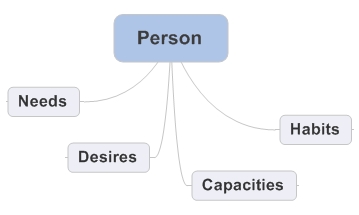
 In his Emotion in Social Life Derek Layder (2004: 13) argues that there are three main objects which individuals seek to control through the exercise of their agency: “the self as object of its own control, other people and the individual’s current life situation”. Through an understanding of our own characteristics – our needs, desires, capacities and habits – it it becomes possible for us to modulate our reactions to suit the demands of our situations. Through an understanding of these characteristics in others we are able to predict (and thus control) the reactions of the other individuals who populate those situations. Finally, through harnessing such understanding and exercising it in particular situations, we are able to control our life situation as a whole: the emergent sum of different life sectors (work, leisure, private life etc) which each consist of an array of interconnected situations.
This has left me thinking about the way in which our characteristics are rendered pertinent to our attempt to negotiate (a) particular situations (b) life as a whole. Layder plausibly argues that “the common focus of these possible objects of control is the individual’s dependence on them for the fulfilment or satisfaction of needs, concerns and problems” (Layder 2004: 14). So while disinterested reflection upon our personal characteristics is certainly possible, it is the exception rather than the norm. As with the other possible objects of control Layder discusses, our stance towards our characteristics is inherently a pragmatic one. We ask questions of our selves as and when they are posed by the situations we confront:
- Why do I always act that way?
- Am I capable of doing this?
- Do I want to do that?
- What do I need to do this?
 Mark Carrigan