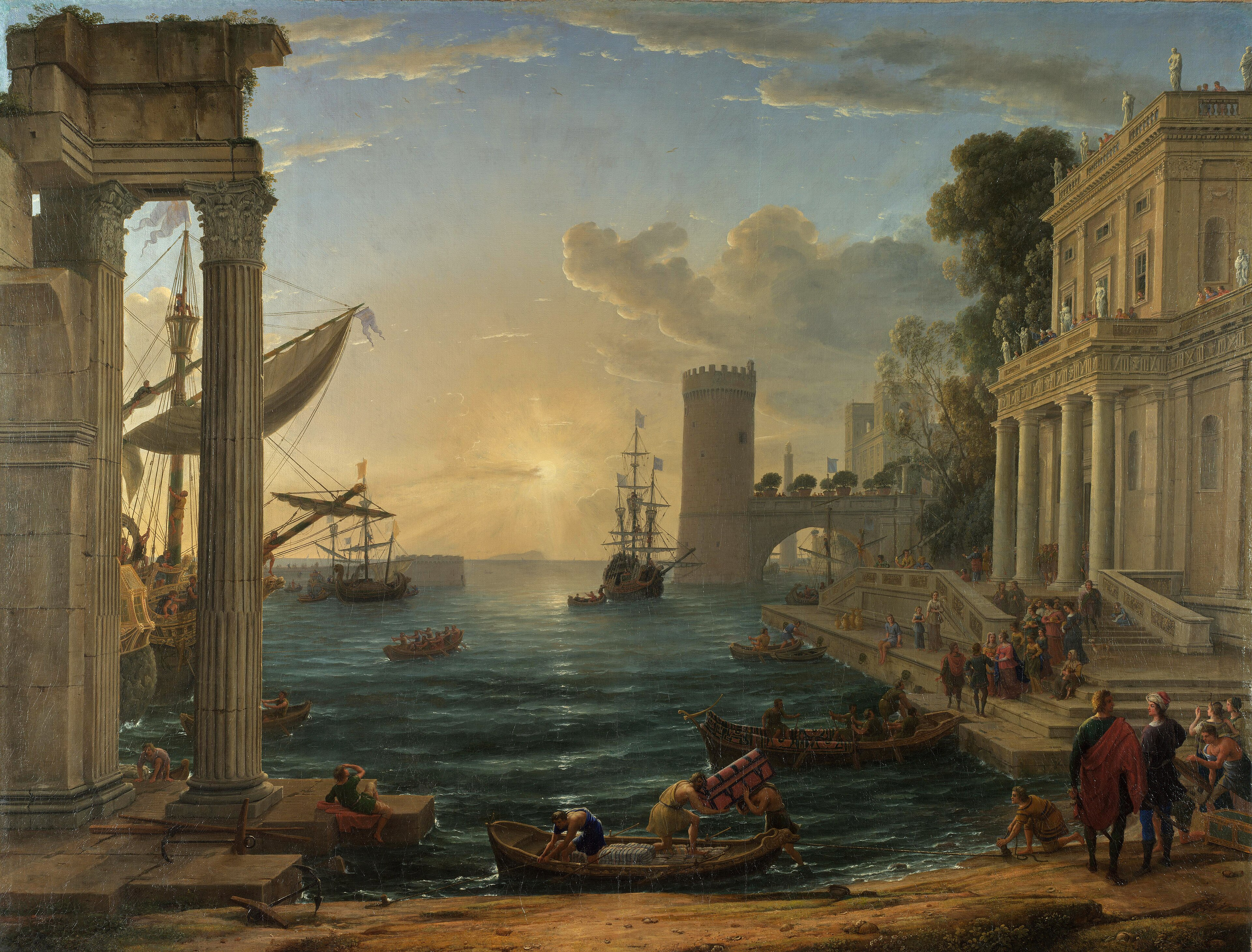
I stumbled across one of my favourite landscapes in the National Gallery this week. It’s a painting by Claude I originally came across at a very particular point in my life, dominated by a sense of departure and arrival in a slew of changes which were at points overwhelming. It left me in a bit of a reverie where I felt the need to articulate why I’d found this painting so moving. It was interesting to physically encounter something I’ve looked at so often on a screen, particularly when I wasn’t expecting it.
I think it presents an idealised sense of journeying which conveys both the drama of departure but also the promise of arrival. There’s a dramatisation of purposeful action here but in a way which brings out the ideal quality of such action. There’s so much movement in this landscape but there’s also a calm orderliness to it, with the coordination of the people reflected in the relative calm of the ocean and the tantalising haziness of the sun. It’s unclear what’s beyond the horizon but we can be certain it’s going to be important. It leaves me with a sense of resolute commitment that for some reason always makes me think of the opening chords of Baba O’Riley:
There’s a promise of harmony between two sides of myself encountered here: the part of me which leaps straight into something without thinking about it and the part of me which has a deep faith in planning and preparation. It captures a sense that orderliness can be a dynamic and exciting thing, creating harmony rather than leaving oneself cut off from the world. At a point in my life where everything felt unsettled I found a profound calm in this painting’s sense that movement and change can take place in purposeful, structured and rewarding ways. You’re going on a journey, that’s beyond your control. But it’s up to you what kind of journey it is, where you’re going and how you’re going to engage with it.
It was interesting to come back to this in late summer 2026 when my psyche is no longer dominated by an imaginary of arrivals and departures. It was only then that I felt moved to ask “why do I like this so much?” because it opened up a gap between myself and the painting as a cultural object. I could step back and reflect on it more because I wasn’t seizing on it in the way I retrospectively realise I previously did. It could talk to me now in a way it couldn’t quite then because I was so hungry for the feeling the painting provoked in me.


