
I ran my first marathon four weeks ago. I resisted writing about it at the time because I wanted to metabolise the experience before I put it into words. I was full of confidence earlier this year before a whole series of niggling injuries (knee, toe and hip) left me failing to get through my penultimate training block. I was getting stuck on 12-15 miles because each interruption knocked me back sufficiently that it felt a bit like starting from scratch. I eventually got through it after finally accepting that you do have to do the physio exercises every day and in full if you have a serious problem. It meant that I was ready to power through the final block in September at which point I discovered that running sixteen, seventeen, eighteen, nineteen and twenty miles on successive weekends is really fucking tiring. This is what I wrote towards the end of that block:
I’m just about physically ready. I’m confident I’m psychologically ready. But that has meant a healthy dose of fear as I’ve come to understand that this first marathon is likely going to be one of the most difficult experiences of my life, at least in the final stages. I’m absolutely certain this is going to be something I will continue to do for as long as I’m physically capable of doing it. But I now understand there’s an element of darkness in it which I just hadn’t made contact with when I wrote that cheerful post six months ago.
https://markcarrigan.net/2026/09/13/i-run-my-first-marathon-in-five-weeks/
I really hadn’t understood the cumulative load of training for distance until I’d experienced it. Each week you are running a longer distance on legs that have not recovered from the previous week. I’d also never really understood how to carb load until experiencing the most ravenous hunger I’d ever felt in my life. I think the slightly bleak feeling of this blog post (after my first 17 miles if I recall correctly) came because I was underfuelling. Once I started to listen to these signals I rapidly began to understand what nutrition I needed, including adding a generous quantity of bread to each meal and carefully upping my quantities. I also got to the point where nutrition during the run became fairly automatic. I was pleased to realise that for the final two training runs, reaching for gels had become completely habitual. My watch would buzz for each mile. Every three buzzes I would grab a gel in a now often automatic movement.
Once I cracked nutrition it was still hard but it no longer felt like each long run was a masochistic descent into hell. Indeed by the end of the block I felt very confident. The final twenty mile run was partly in the rain. I had worried that my resolve would fold if I had to run for hours in the rain but actually I discovered that it didn’t really bother me. Perhaps more importantly a sense of calm descended on me in the final two miles of the last run: “this is just running for a really long time when you’re really tired“. The sense of some strange cosmic mystery to what I was doing evaporated and, for the first time, I genuinely wanted to continue that day. I forced myself to stop because I knew I needed it to be ready for race day. But I could feel for the first time that I was capable of running the full distance.
The problem is it left me overconfident. Newly relaxed about the undertaking, I was less conscientious about preparation than I otherwise would have been. When it came to the race I ate too much at breakfast and drank too much tea. I also turned up way too early, ultimately leading to me sprawling out on a couch for an hour reading a book about literacy which wasn’t exactly the best way of getting into the headspace for the race. The design of the Yorkshire marathon compounded this because the first few miles are in the stunningly beautiful York city centre: a place which has all sorts of memories associated with it for me. It left me ponderous and distracted as I admired the architecture while we jogged around the centre.
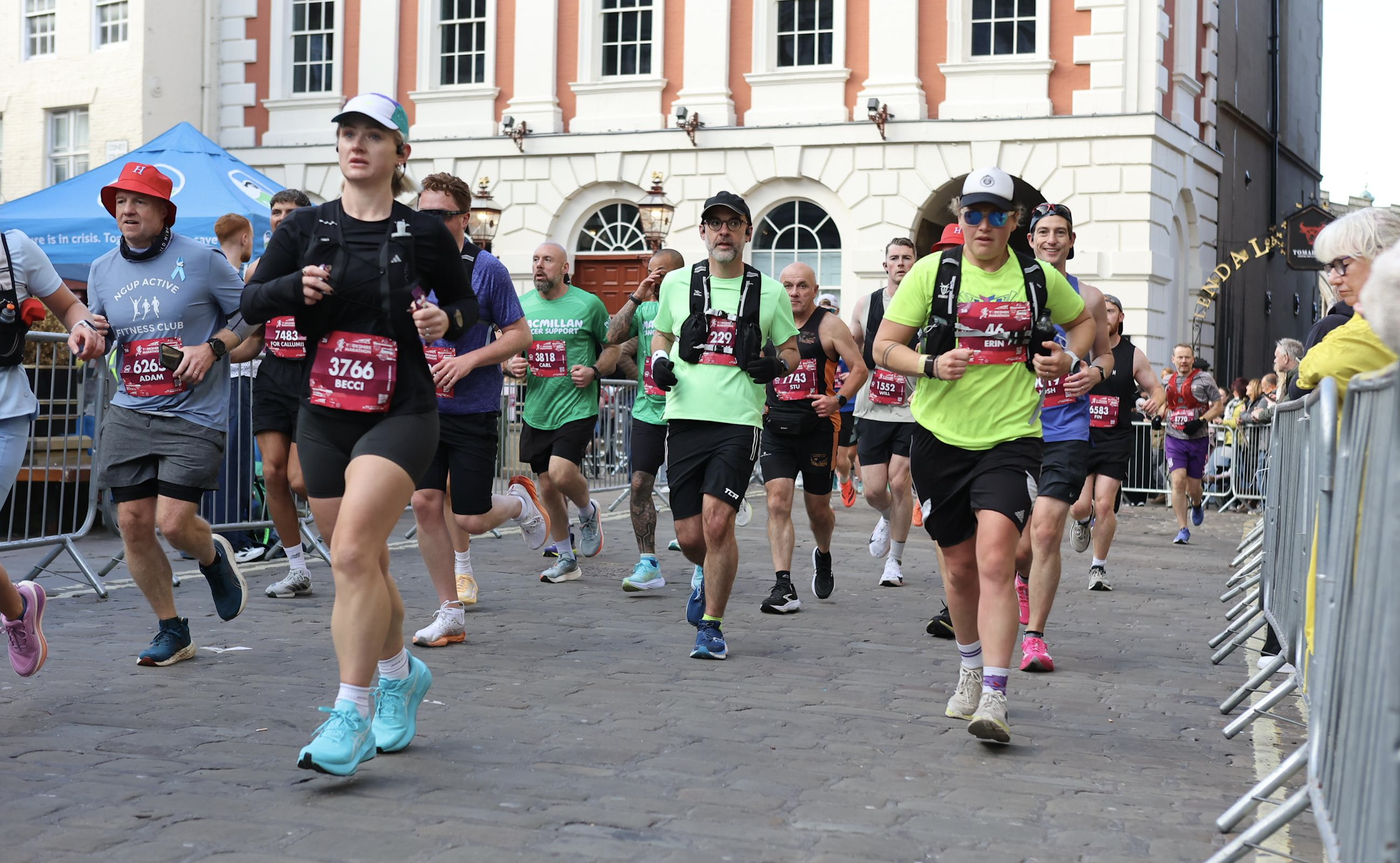
The problem is that I barely tracked my pace in these initial miles. I had learned to monitor my pace for the first mile or two then rely on bodily sensation to sustain it in a process which my watch data suggested was reasonably accurate. I also took a gel early for reasons I don’t understand… I wanted a snack while I looked at the pretty buildings? The issues started when we left the city centre and began the long route into the Yorkshire countryside. I had to use the toilet way too early (stupid tea) which further contributed to a loss of rhythm. I only started trying to monitor my pace and fuel properly around five miles in, at which point my watch felt horribly unreliable to me. At the time I thought it was something about the satellite connection but I think it’s much more likely that my increasingly anxious over-checking was creating a feedback loop. I kept adjusting my pace in response to the watch which made the watch change which in turn made me adjust my pace.
I started to worry that I couldn’t trust my watch. At which point I noticed that I was already near the 4 hours 30 mins pacer so I decided to follow him. The problem was this left me running in a pack on narrowed and crowded country roads which meant I was paying far more attention than I was used to just to avoid bumping into people. By seven or eight miles I had still not relaxed into a comfortable rhythm where my thoughts could wander as my running went onto autopilot. My 5G also failed and I realised that my running playlist wasn’t actually downloaded. This left me without my familiar cues and again made it difficult to relax into things. It didn’t feel like a disaster but I was slightly on edge up until around mile fifteen.
It was at this point that I realised I’d managed to drop two gels. Not only was I already out of sequence but I now had only one gel to last me for the last eleven miles. This was the point at which I started to get quite stressed out. I could feel that I was already running out of fuel but I knew that if I took my remaining gel now there was a serious risk I couldn’t finish the race. I briefly felt myself beginning to spiral into self-recrimination before I took control of the process and asked myself what could I effectively do now in the situation I was in: (1) forget about following the pacer and run more slowly (2) make absolutely sure I grabbed gels or a glucose drink if there were stations (3) collect as many sweets as possible from people in the crowd. The sheer number of jelly babies and percy pigs being offered made this surprisingly easy even if it did sit uneasily in my stomach once I’d had three miles of taking a few from every offered tin. It also slowed me down to do this so consistently. But things started to feel in control again before, thankfully, there were gels being offered at mile 20 for the first time (!?) in the race.
I finally felt under control in mile twenty. Yet I had never run beyond twenty miles before and I wasn’t sure what to expect. I’d had some vague sense this would be a magic threshold which somehow felt different whereas in reality miles twenty one and twenty two just felt like more of the same. If anything I felt marginally better because I was back to a proper fuelling rhythm and even got some sugary orange squash from a passerby which I had been dying for. I’d switched to my acid techno playlist for the final stretch which I knew would have tempted me into going out too fast if I’d listened to it from the start. But twenty to twenty three were pretty uneventful with my mind finally shutting up once I no longer had to worry about fuel. It’s a stage I was reliably reaching in training by fourteen/fifteen miles but it did eventually come once there was no longer anything urgent to be reflexive about.
It was at mile twenty four when we reached the outskirts of York that it started to feel weird. I don’t remember this bit clearly but I do recall feeling extremely upset in waves. I think I was crying at one point. But every time I had a wave of feeling upset I then got a wave of energy with it. At this point I think I’d switched to just having the same track (below) on endless repeat. It felt odd to be back in the city after three hours of picturesque villages punctuated with long, boring and surprisingly crowded country roads through blandly pleasing countryside. By mile twenty five though I was really starting to struggle.
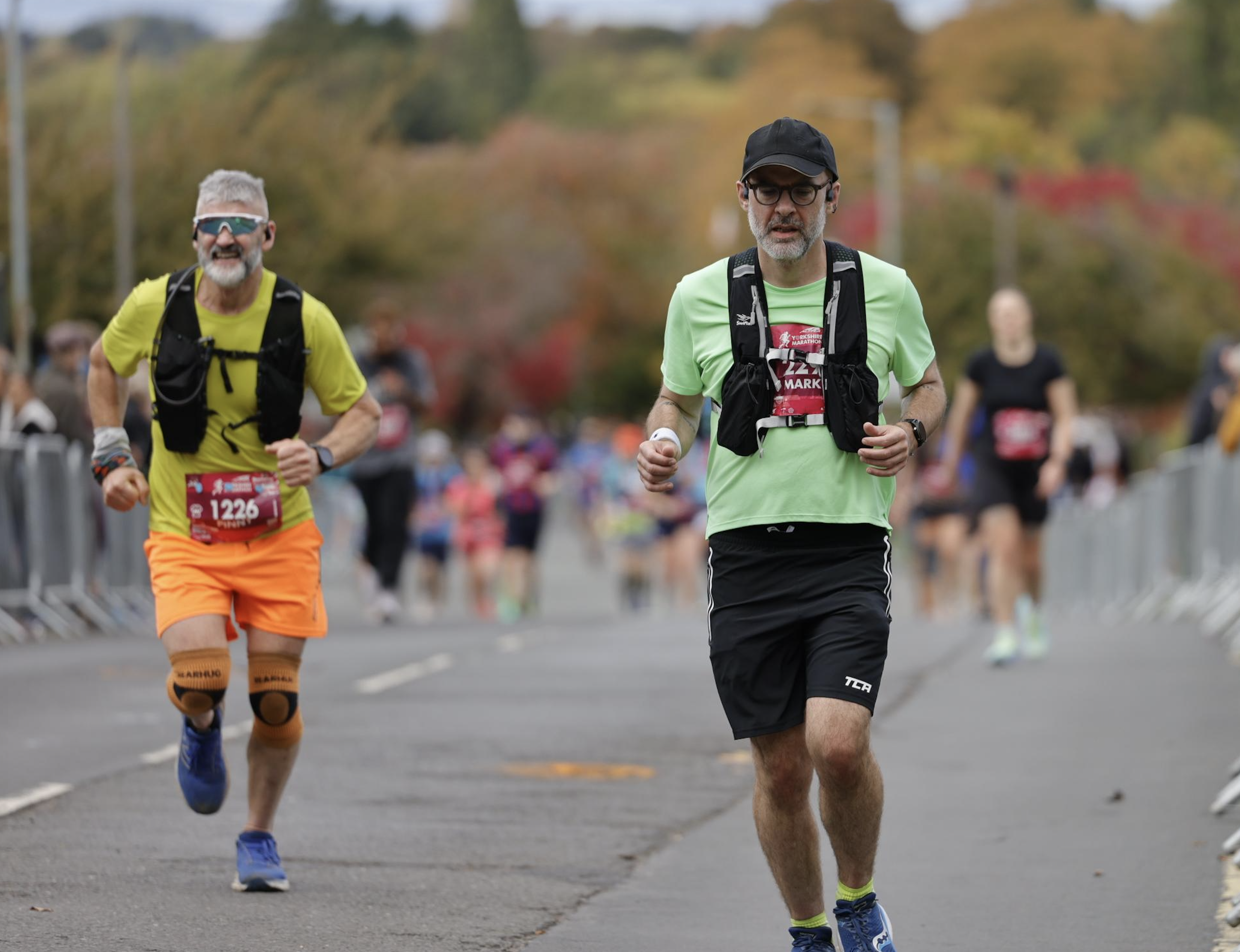
I found myself reasoning with my legs which reluctantly proceeded until… the final hill. I was warned about this but I still wasn’t prepared for it. It wasn’t a huge incline but it was half a mile of consistently uphill at the end of the race. I think the photographer here captured the moment shortly before I hit my limit. “Fuck you, we’re done” said my legs. I had never experienced such a complete failure of control. I was desperate to continue and they just would not move. I did fleetingly panic that I wasn’t going to be able to finish the race but then realised that they would move, just slowly and very much walking. I’ve never had such a vivid sense of my mind having a conversation with my body before. I eventually walked up the hill with a mounting sense of frustration with myself.
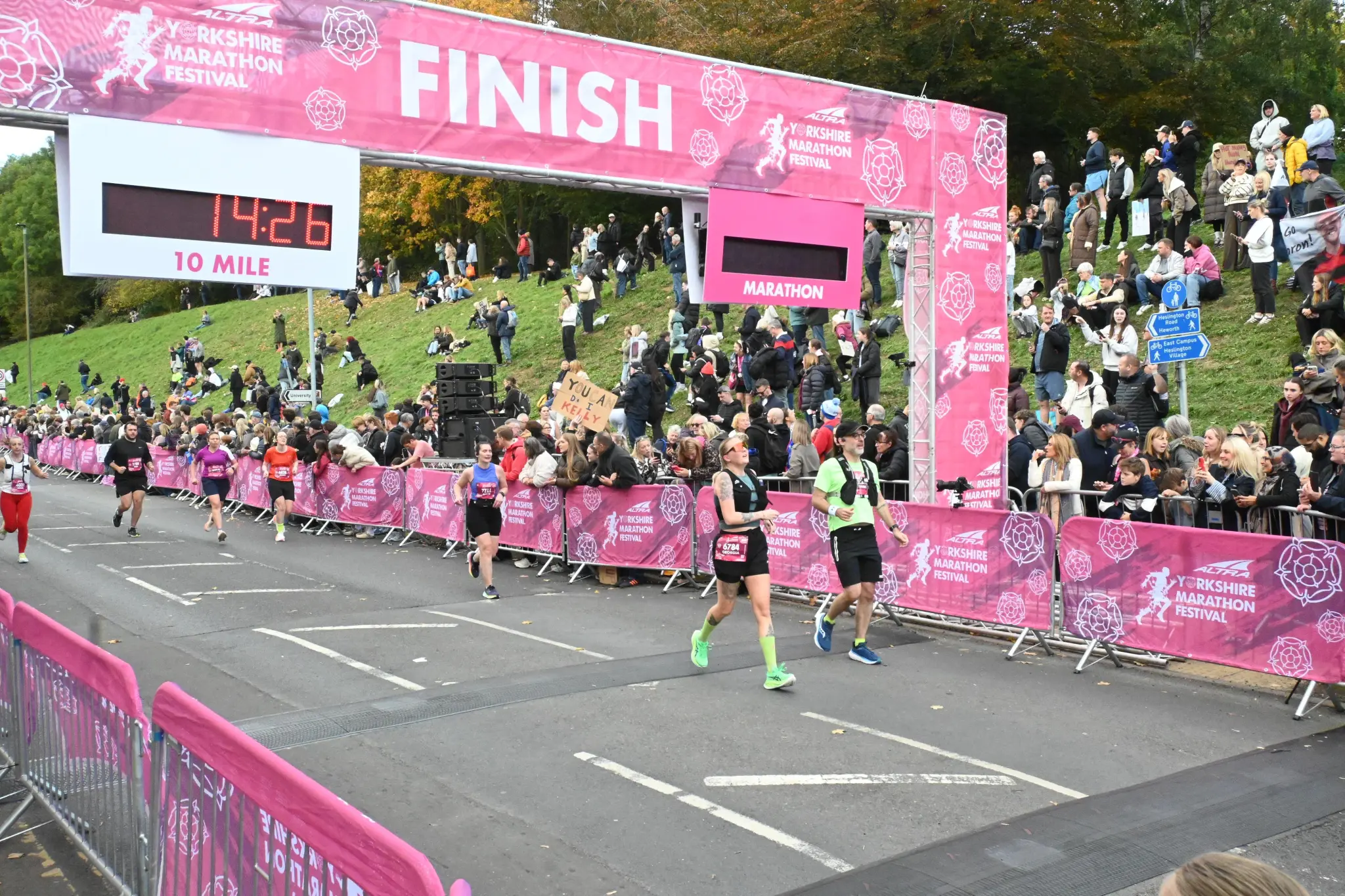
Once the hill was over I was viscerally relieved that I was able to run to the finish line, albeit slowly. I came in at 4 hours 46 mins. Before the injuries I was aiming for under 4 hours. Immediately before the race I was aiming for 4 hours 30 mins. I was annoyed with myself afterwards because I am absolutely confident I could have reached that goal in this race if I had stuck to the plan. I think just walking up the hill rather than running added at least four minutes to the overall time, let alone the other minor disruptions. I realise now that under 4 hours was never on the cards for my first marathon. But I suspect I had enough fitness to get me down to 4 hours 15 mins if I’d handled the race better.
I’m glad in a way I made these mistakes because I learned so much from this race. It honestly hadn’t occurred to me that sticking to a plan is much harder when you’re in a large event away from home. My half marathons had all been relatively local and my plan had been much simpler. I’ve just split paced half marathons down the middle in the past and it works for me. I’d also assumed that all races had a generous supply of gels throughout but seemingly not. I felt sufficiently frustrated by the hill in particular that I immediately signed up for York next year. I will beat that hill. The plan for next year is to go for 4 hours 30 mins in the Manchester Marathon in April and then go for under 4 hours when I do Yorkshire again in October.
I understand a little more now what I meant when I referred to “an element of darkness” in that earlier blog post. The thing that’s pulling me into this is the element of controlled demolition about the training and the race itself. Can you push yourself to your limit without exceeding that limit? Can you stay face-to-face with those limits in a controlled and careful way? There’s an interplay between the reflexive and the psychic here which I find intoxicating, in a way that felt quite literal in the twenty-fifth mile. My memories of that final hour, particularly before the hill, are dreamlike and somewhat hallucinatory. I’m still not quite sure what happened there but I want more of it. This will I suspect involve pushing the frontier because the sense of mystery which pervaded the marathon is now gone.
I’ve started looking at a potential first ultra in January 2028. I am terrified of the weather but otherwise it seems like the perfect first ultramarathon for a number of reasons. I’m treating the two marathons next year as a time challenge but also an opportunity to practice the practical steps I thought I’d nailed in training but completely messed up on the day. I’ve also been persuaded that I need to start doing strength training on my legs (as well as keeping up with reformer pilates) because otherwise going forty miles plus will likely break me. But honestly now I know what it feels like to finish a 26 mile race, I need to know what it feels like to finish a 40 mile race. For someone who has always lived in his head, perpetually in thrall to the signifier, distance running feels like therapy to me. Each time I meaningfully push myself (in training runs, not just in races) the split I’ve always experienced between my mind and body further heals. Indeed I’m not sure I even do feel much of a split any more after this year’s running.
I wish I had started this much earlier but perhaps I would not have been ready for the psychological challenge of it until the last couple of years.